

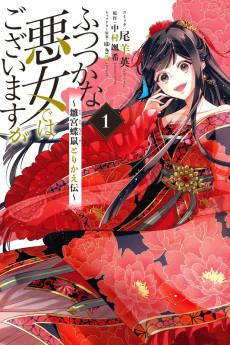
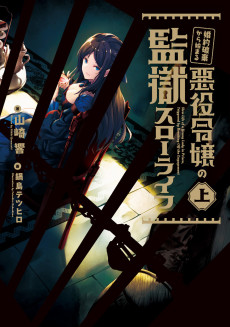
THOUGH I AM AN INEPT VILLAINESS: TALE OF THE BUTTERFLY-RAT BODY SWAP IN THE MAIDEN COURT
STATUS
RELEASING
VOLUMES
Not Available
RELEASE
December 28, 2020
CHAPTERS
Not Available
DESCRIPTION
In a kingdom inspired by historical China, five clans put forth their maidens as imperial consorts–but only one will be crowned empress. The frail and beautiful Kou Reirin, the so-called “butterfly” of the imperial court, is a shoo-in to marry the crown prince. But when “court rat” Shu Keigetsu lashes out at her during the glittering Lantern Festival, it’s Reirin who wakes up in the dungeons! Body-swapped by her assailant to steal her position at court, Reirin’s plight seems dire…to everyone else! Now that she’s got a robust new body, not even the looming threat of execution can stop her!
(Source: Seven Seas Entertainment)
CAST

Reirin Kou

Keigetsu Shu

Kenshuu Kou

Gyoumei Ei

Keishou Kou

Keikou Kou

Unran
CHAPTERS
RELATED TO THOUGH I AM AN INEPT VILLAINESS: TALE OF THE BUTTERFLY-RAT BODY SWAP IN THE MAIDEN COURT


REVIEWS

coolkat122
Though I am an inept Reviewer!Continue on AniListThis is all just based on my own thoughts and feelings for the book, okay?!
I’ve finished vol 1 in just a day and a half because I couldn’t put it down! This was just too good for me!!!
Keigetsu really thought she was getting herself the good life when swapping bodies with Reirin but boy did she underestimate how ill that girl’s body truly was.Tho I will admit I was a little tired of the kind-hearted Mc trope but I think it’s done real nice here (not that there’s anything wrong with that trope, it’s just as I said I was growing tired of it), in TIAAIV Reirin is as kind as she is due to her just feeling that it’s too much energy to do anything else, she was so sick that holding grudges and having fits of anger only worsened her health so, she learned a long time to just let things go and it’s because of that reasoning I felt that her just not being angry with Keigetsu and just living her life freely in her new healthy body to be agreeable with me.
I do feel some pity for Keigetsu, but not much due to her nasty behavior towards those of lower rank than her, she tried to get an innocent man killed and if it wasn’t for the prince dude having a clear mind and level head who knows the poor guy could have probably hit the bullet!
So, any sympathy I hold for her are in small margins.
Now for the Prince, I do like that he is some what noticing how off “Reirin” is behaving though it’s only understandable that he doesn’t just automatically assume that his beloved Reirin and Keigetsu have swapped (because like just how would you naturally come to that conclusion?!), I don’t however like him at times when he was all like women wearing cover up their true looks and to appear prettier than what they naturally are, is kind of an annoying mindset that some love interest or dudes in romance hold and it’s usually to help show how different the Herorine is when compared to “other girls”, she doesn’t have to be, the main heroine can be like other girls and have similar interests and whatnot.
Finally onto the dude I am sure is the Main Love Interest, he’s okay, he doesn’t seem to have an interest in women (other than sex when the mood strikes) since all they seem to like about him is his looks and powerful position which I get if that was all that I saw others liked in me, I certainly wouldn’t really want much to do with them, just like he doesn’t really want much to do with them.
He’s pretty levelheaded himself (more so than his half bro the Prince which duh of course he is cuz he’s the main honey bunny so he needs to stand out and stick up for Reirin to help catch her eye!).
I think that’s all I can say about him since he hasn’t been shown too much and tends to be pretty stoic and keeps to himself.
I recently purchased vol 2 so, I look forward to reading it and writing my thoughts on that as best I can!

Rastrelly
Masterwork of extended fluffyness, somewhat in the need of better technical writing qualityContinue on AniListAs it happens often, my old, remarkably smooth in-skull thingie is forcing me to spend time writing probably pointless stuff just because I need to vent my admirations, however unhealthy they are.
So, we are talking the light novel series called “Though I Am an Inept Villainess: Tale of the Butterfly-Rat Body Swap in the Maiden Court”, which completely respects the requirements set by ISO 9001:69 for the anime, manga and LN title schemes.
While I’m waiting for the anime version to end so that I could post my pre-meditated thoughts on that when it is complete, and I’m finished with rectifying inconsistencies if those are to appear in the last two episodes, I, of course, went in and read the books, which moi usually does when it likes something.
So, did I like them books?
…
…
[drum roll]
…
Yes.Though I have a small cart to express the amount of finger-shaking on the subject matter.
Oh, and yes – this review brazenly assumes familiarity. So, SPOILERS EVERYWHERE!! You might already be spoiled! Do reevaluate your behaviour, until it’s too late!
Now, feeling the feeling of feeling déjà vu, I need to express a crucial point that will be essential to understand this review: there are a bunch of articles, posts, videos screaming “IF YOU LIKED APOTHECARY DIARIES YOU’LL LIKE THIS!!!”. I think this outlook is wrong, detrimental and incorrect at its core.
What is
a man? Just a miserableApothecary Diaries? It is a threefold snake of thin historical parallels, systemic approach to narrative, layered foreshadowing boosted by recontextualization, and on top of that it has its character roster, comedic elements etc. Overall I’d categorize AD as not light novel series (this format is honestly somewhat detrimental to it), but a series of fully-fledged classic novels, quite on the level. It barely ever indulges in “meta” elements typical for light novel format, it actively indulges in immersiveness of environments, and it almost always keeps grounded foundation even for the most lighthearted moments. This is what I especially value in the AD as the series I love to engage with.IV does not do almost any of that. This is primarily an emotionally driven endeavor, even when it does build some grounding for the events. It thrives when using meta elements, slight genre stereotypes, character archetypes etc. It’s a story where crops grow in three days, ladies in waiting know kung-fu, everyone throws around magical soul energies of Chinese Zodiac, bad guys are complete arseholes, good guys are good on thermonuclear level, and it all somehow works.
So no, IV is not AD, it is an entirely different beast, and will be treated as such.
Now, there are 10 LN volumes accessible at this point, which I’ve diligently (and hastily) consumed with differing, but generally high enough level of enjoyment to actively read from my phone while walking, walking the doggo, riding the subway, the trolleybus, and while pretending to be working.
It’ a great pulp read. It’s light (duh!), quick-witted, engaging and easy to chew. Luckily, it also has some proper nutritional value, otherwise I’d drop it long ago.
Now, the core aspect of IV is it’s non-complex nature. This is not a text that tries to wow you with some kind of eight-step complex uber-intrigue. It’s simple, readable and tightly constructed, which is exactly what it needs to be to do what it does.
Now, what it does is a harder question to answer in a way that does not sound like some kind of sappy cringemongering. IV is clearly a “otome-adjacent” literature. Or, in other words, it is probably aimed at the category of earthly creatures that might be sharply identified by the philosophical and craniological icon of the century Measurehead as “The Men of Wö”. It also revels in putting some of the traditional otome tropes on their head (not that it’s some kind of unheard innovation, mind you).
The core, even the soul of the entire story is Kou Reirin, the court butterfly. She’s one of the five Maidens, assigned by the five imperial clans to be the future consort, or, potentially, wife, to the current crown prince of the Ei Empire, Gyomei. She also happens to be his cousin, the daughter to the sister of the acting Empress.
Gyomei loves her to death, but they clearly fit better as siblings over husband and wife.Reirin represents the clan associated with the element of Earth, and her clan fits the bill: Kous are nurturing, sturdy, stubborn, pragmatic and tend to solve things in the most straightforward way. There are also four other clan Maidens – Kin Seika (represents metal, clan of artists and merchants), Ran Houshun (represents wood, clan of intellectuals and schemers), Gen Kasui (Gen represent water, it’s a military-centric clan with even more stubborn streak than Kous) and last but not least, Shu Keigetsu (Shus represent fire, which means they scream a lot (and are a decisive bunch (but they do scream a lot))). The girls are “curated” by assigned Consorts (concubines) of the current Emperor. All these women compete for Emperor’s favour, both for personal gain and as the clan representatives who are there to maintain Imperial neutrality and balance between the interests of the five clans.
Now, the inciting incident of the story is the moment, when Shu Keigetsu pushes Kou Reirin off the tower during a ceremony of presenting embroidery to the gods on occasion of meteor shower and comet flyby. Everyone is festive, making wishes, having fun, But then, SUDDENLY, Shu Keigetsu screams that she wishes that “that awful woman was gone” and pushes Reirin off the pagoda’s balcony.
Keigetsu, you see, is a wizard (okay, okay, “Daoist Cultivator”; I’ll call her a wizard, no care in the world), and, as we’ll find out later, achshully a very much epic wizard. But neither did her parents care, nor everyone else (wizardry is forbidden). To all she was overly tall, uncultured rat, a shame of a Maiden, and the court’s Sewer Rat. She was despised by almost everyone, and she gladly returned their input – abused her court ladies, threw tantrums, but got subservient to the high nobles and the prince. She hated everyone, including herself, but whom she thought she hated the most was the “court butterfly” – Kou Reirin (who is, I remind, our main character, though it might not be obvious yet; she’s, after all, currently busy falling off a tall building). Reirin, from Keigetsu’s perspective, had all: she was hot as heck, the prince, Empress, Emperor himself and everyone else swarmed her with affection, gifts, praise. She held herself cultured, knowledgeable, distant; neither abusive, nor friendly. She had talent in everything – she danced like a goddess, made magnificent embroideries, could talk poetry, literature, scriptures, history, science, never arrogant, never clumsy. The manifestation of annoying perfection.
So, Keigetsu stole her body, cast the spell to silence her, fabricated personal information leak to close the option to deliver partial personal info, and framed her for her own murder. Quite a trick for a court rat!
Now, that’s where the karma enters the stage.
You see, Reirin was all that Keigetsu saw – cultured, distant, perfect, - despite a storehouse of chronic illnesses. The girl could barely walk without fainting. Add there an elephant-sized guilt complex, caused by her own mother, a similarly frail lady, dying during childbirth. So, Reirin has become an obsessed workaholic. She taught herself medicine to try and heal herself. She worked with animals to test potions and serums. She dug the ground to grow them. She trained with a sword and a bow to become stronger and more durable. She learned music, poetry, scriptures, dancing to compensate the world for the loss of her talented mother.
Yes, she’s fawned over, especially by those close to her – for a very good reason. One of those is stopping herself from overworking to death.This is the world Keigetsu throws herself into. Oops. We need to discover walking, we need to hide our lack of talents, and we need to pretend to be the overworking guilt-ridden girl everyone expects to see. Guess how it goes.
But that is not the scary part. Keigetsu herself was a fire clan woman. So, tall, temperamental, healthier than an average horse. And now, when Kou Reirin has taken control of that body,
THE ENTITY WAS UNLEASHED.
Now, I remind the fine reader that in this tavern we spoil. So, SPOILERS.
It would be a bad story if all was that simple. I praise simplicity, but simple and primitive are two big differences, as they say in Odessa. Of course the swap was a trick by an external force. Of course the plan was to execute Reirin-as-Keigetsu after murder attempt, and the illness to kill the unprepared Keigetsu-as-Reirin.
When neither happens, harassment and literal curse come into play.
The final target – power grab by one of the four consorts as a revenge plot against the Empress. And this plot eventually pushes the two opposite girls together. For Reirin, Keigetsu becomes her “miracle comet”, the one, who gifted her, even not for long, the opportunity to be free; and Keigetsu, getting stuck in a very precarious position, especially when her “cover” starts falling apart, suddenly understands that not only she was manipulated by one person she genuinely trusted, but the girl she thought she hated the most was, au contraire, the only person on the planet willing to see past her hysterical, unpleasant exterior to see the scared yet stubborn creature inside. The core clan value of the Kou – backbone. The one thing Reirin seeks in other people, she finds in her “miracle comet”. So, they do become as close friends as they were opposed to each other.
And volumes beyond 2, basically, explore said friendship and the network of interactions stemming from it. After all, it cannot be smooth sailing when the “court butterfly” is an overachieving do-gooder messiah with suicidal tendencies, while her best friend is fiery impulsive, halfway hysterical fire wizard.
Keigetsu and Reirin made wishes on the night of the comet. Reirin wished for her life to become easier and to get a friend. Keigetsu, on the other hand, desired for “that awful woman [to be] gone”. While initially implying Reirin, by now it should be quite obvious she meant herself. Quite clear their wishes, in a way, came true. Reirin did get a friend, and the one who properly pulls her out of the bottom of the proverbial well, on the way making her life easier; Keigetsu also starts to disappear – not in a way of erasure or character assassination. Her self-destructive self-loathing image starts falling apart, revealing a still abrasive and often unpleasant, but at times a person fascinatingly sincere and naturally benevolent in her outlook.
The following stories start adding the three other maidens to the mix. Sometimes the girls plot against each other, sometimes they have to take a collective stand against abusive practices.
There is genuine character progression. Ran Houshun plays an innocent child while being a manipulative bastard with no value for lowborn lives. But she does have genuine protective streak on her subjects, and their animosity with Reirin progress in a set of interesting directions. After all, they have to play maidenly acceptance and even work together.
Kin Seika is an artistic spirit with high values and solid principles. But her clan is ruled by the merchant branch, the people with principles at times as low as it gets. As low as threatening to sell their maiden off into literal sex slavery.
Gen Kasui, the stoic military type wearing poker face all the time, is burned up by revenge for her sister, who was framed and presented as a traitor, and then burned in an unfair trial. She can get very violent when stuff comes to this matter.
And even the Emperor himself has some very dark past, leading to his policy against wizards.
These people go through certain suffering, partially self-inflicted, partially external (as Houshun’s fingernail will confirm), but eventually they are forced to start appreciating their community above their affiliation due to said affiliation often becoming the violent, hypocritical burden, harmful both to the Maidens, to itself and to the Empire as a whole.Most novels build themselves around the main duo's body swap taking place for one reason or another at an unconvenient time. Sometimes it’s a mishap, sometimes it’s intentional, but it’s never safe for the two girls involved. They clash with persecution, dangerous individuals, political rivals, even Imperial Secret Service, and in the end, what’s funny, the truth often works as the best weapon.
There are some genuinely hilarious scenes when either Reirin, or Keigetsu sweat bricks to pretend to be another one, and it’s especially funny when they fail so miserably, half of the people present need actual effort to keep their faces straight. Considering Reirin, in most cases, being a bad actress (the one case she managed to play proper Keigetsu’s hysterical nature required literal water torture, written, by the way, in a very sobering way to finally come to understanding that acquiring a real friend has finally taught her to have at least some semblance of fear of death, and even then not because she was afraid to die per se, but because she felt she’d betray her beloved friend by leaving her to fend for herself), plays her protégé much worse than Keigetsu does, it gets even funnier.
Also, interesting moment of somewhat allegorical/metaphorical writing is that many characters in the early volumes are surprised at Keigetsu (possessed by Reirin) looking beautiful. The wizard lady is described as too tall, somewhat clumsy girl, that is always hunched over a bit. When Reirin with her perfect posture, sense of style and dancer’s movement occupies this “vessel”, it becomes clear that Keigetsu herself is a beautiful girl, even if in non-standard way. Of course, over the course of the narrative, as Keigetsu’s self-image improves, she does become more beautiful both inside and outside. Not to mention that, considering what feats Reirin pulls off in her friend’s body, Keigetsu is already quite in shape to begin with.
I honestly love what this story does repeatedly – it builds up the momentum for properly moral, human people to push through decades, sometimes centuries of hostility, repression, abuse, hatred or fear. It’s not something new, it’s not written particularly well, but it’s very effective at what it does when you feel like letting the thing do the thing.
What I also love about this all, and what is often missed in the stories trying to build some kind of ridiculously good main character, is that neither Reirin, nor Keigetsu, nor even their opponents, are dumb. Reirin especially – she’s a perceptive, politically aware girl, whose dedication to knowledge does not go to waste. She’s not a character who says “Pweeeease” and makes puppy eyes so that her assailant said “Awww!” and suddenly made himself a good guy. No, she’s the girl who will setup an elaborate scene in which she risks all to get the point across so brutally, the other party has to reevaluate half their life choices, based on investigation of their motives and actions. I can totally respect this approach to character writing. I don’t want my ultra-good guy to be an emotionless demigod or bumbling fool getting through by pure luck. I do want my characters to cheer for to be the authors of their success. After all, as they say, the good should be with the fists.
And another thing to praise – the author is not afraid to meaningfully (albeit lightly) touch some really serious subjects. Treatment of chronic illnesses and their effect on people, revenge, torture, classism and racism, sex, human and drug trafficking, discrimination, harassment and abuse both of post and familial relations, blackmail, obsession, and even rape, all are woven into the text reasonably and, for the most part, tastefully and with the weight they imply.
Now, the writing itself is far from perfect. The author often enjoys lengthy asides providing not much fresh meaning to the events. it could work as a character study, if the characters studied were receiving a new light. Especially egregious case was the Emperor’s story in volume 9. Yes, the story itself is touching. But it was more or less fully spelled in fragments throughout the previous book, and the big final twist was visible from across the ravine.
This goes for many of the twists in the story. The involvement of Rans in Volume 4, the identity of the valet in volume 10, the culprit in volumes 5-6 are all easy to detect far too long before they arrive, and considering the story really isn’t about twists themselves, it might’ve been better to just open them from the start and let the reader to observe the ensuing antics.
Language itself is also quite plain. Rarely do some flowery metaphors or extended descriptions come along, while they’d really improve some of the scenes. For the most of its volume, the text of the LNs is written in a very matter-of-fact manner, quite dryly, contrasting the warm and fuzzy contents.
In the end, what really sells this story is the core protagonists. Neither of them are perfect, but Reirin being the manifestation of everything good and glorious, and Keigetsu slowly uncovering that flame not just burns, but also warms, is enough for me to recommend the series.
COMMENTS
0 Comments
SIMILAR MANGAS YOU MAY LIKE
 NOVEL ComedyTearmoon Empire
 NOVEL ComedyScrapped Princess

SCORE
- (3.75/5)
MORE INFO
Favorited by 57 Users