

PORCO ROSSO
MOVIE
Dubbed
SOURCE
MANGA
RELEASE
July 18, 1992
LENGTH
93 min
DESCRIPTION
Take flight with "Porco" Rosso, a valiant World War I flying ace! From tropical Adriatic settings to dazzling aerial maneuvers, this action-adventure from world-renowned animator Hayao Miyazaki is full of humor, courage and chivalry. When "Porco" —whose face has been transformed into that of a pig by a mysterious spell— infuriates a band of sky pirates with his aerial heroics, the pirates hire Curtis, a rival pilot, to "get rid" of him. On the ground, the two pilots compete for the affections of the beautiful Gina. But it is in the air where the true battles are waged. Will our hero be victorious?
(Source: Disney)
CAST

Porco Rosso

Michael Keaton

Fio Piccolo

Akemi Okamura

Donald Curtis
Akio Ootsuka

Gina

Susan Egan

Mamma Aiuto Boss

Tsunehiko Kamijou

Grandpa Piccolo

Katsura Bunshi VI

Ferrarin

Mahito Tsujimura
Episodes are being prepared. Check back soon.
RELATED TO PORCO ROSSO

REVIEWS

hoeberries
I'd rather be a pig than a fascist.Continue on AniListI was surprised to find this film had no reviews. Porco Rosso (1992) is a funny, wistful story about flight, war, and idealism, all soaking in this cosy bath of nostalgia. Go watch it! It’s Miyazaki’s birthday today, you know. This might just be his most characteristic movie, featuring the grand sweep of flying, anti-war sentiments, working women, and pig metamorphosis (kinda weird that it happened twice). I suppose all it is lacking is a dash of environmentalism.
What it is not lacking is planes. Miyazaki loves those things. Possibly a bit too much. The flying, the planning, the building, the crashing and burning—within his long list of plane-related work, Porco Rosso pulls this stuff off the best, and is certainly worth a watch even if the subject matter (anthropomorphic grumpy plane pig) doesn’t light up the sky for you. I enjoyed it a lot more than 2013’s The Wind Rises, which insists on telling a long, self-indulgent biography of plane-maker-war-criminal Jiro Horikoshi and kind of forgets that the majority of us do not care about airborne hunks of metal.
Porco Rosso is plenty indulgent itself, described by Miyazaki as “idiosyncratic” in a way he doesn’t believe films should be. He whipped the movie up as a promotional short for a goddamn airline (dream come true for the guy), and he based it off his plane-centric manga called The Age of the Flying Boat (1988) that acts as a campy tribute to aviation. Due to certain real-world events, though, things had to change (more on this later).

Porco is not your typical Ghibli protagonist. He's a chauvinistic, lazy, jaded pig. He was a heroic French pilot in World War I, but after becoming disillusioned with the country he fought for, he set off on his own. We're introduced to him living a cruisy life as a freelance bounty hunter, reprimanding sky pirates in the idyllic Adriatic Sea before sliding into the smoky Hotel Adriano where he sits down, lights a smoke and just looks very, very cool. Naturally, Miyazaki creates a stellar tourism ad for the area.
On the surface, the movie is an airborne romp. A love letter to early aviation, sure, but one that is instantly enjoyable and accessible to those of us that did not grow up in a literal plane factory. The central plotline (extracted from the source material) follows Porco's rivalry with this American caricature named Donald Curtis, and it's consistently (consistently!) hilarious. Whether it's Porco's dry wit, Curtis' campy stupidity, or the delightfully funny minor characters, the laughs persist throughout.
But Porco Rosso is a lot more than that. While Miyazaki and the gang were putting together their fun little airline short film, they were blindsided by the Yugoslavian ethnic war. This news would echo into the movie.

Miyazaki is not just a giant plane nerd. He's a romanticist. A pacifist. An environmentalist. A Marxist. A feminist! He is all manner of good -ists in the world. Spectating the collapse of Yugoslavia's socialist state broke something inside the beloved filmmaker, and he ended up channelling these feelings into his work. How can you live when it seems like the world is going backwards? How can you reconcile that awful feeling of being disillusioned by humanity? To varying degrees of visibility, I feel all Miyazaki movies reckon with these questions.
Porco Rosso puts forth an answer. Become a pig! Say goodbye to your humanity and lapse into misanthropy. It's a bit pathetic, but can you really blame Porco? As I've hinted at throughout this review, this is a funny movie with a sunken heart. Beneath the bright colours and witty gags exists a tragic backstory: Porco lost all his friends in a war that amounted to nothing. The country he fought for no longer represents his injured ideals. Better a pig than fascist. Better a pig than a human.
If you haven't realised, Porco is not-so-subtly Miyazaki. I don't think it's any coincidence that the filmmaker selected a pig as his alter-ego—he always seemed to like them. And, against all odds, it makes perfect sense in the movie. I never once questioned why Porco was a pig, as it just kind of came into focus over time. The benefit of animation, of course, is that the medium can pull this fantastic animal nonsense off so seamlessly.
As such, I actually dislike Miyazaki’s flaccid attempt to link some type of supernatural “curse” to Porco's pig form. That wasn't necessary. I get that he likes his curses, but we understand why Porco is a pig. It just works, and the implied magic only serves to complicate things.

Anyway, meet Fio! Miyazaki ain't no pessimist, so he cooks up one of his signature girls to breathe life into his stinky pig of a man. Fio is this hard-working, passionate girl who builds Porco a plane and comes along with him. In addition to being a strong, likeable character in her own right, she does so much for this movie, ultimately leading Porco back to his humanity. There's the idea that, if people like this are the future, said future might not be so doomed after all.
I will say that, much like in Castle in the Sky (1986), the teenage heroine is at several points presented as honey on a stick for a conglomerate of thugs who thirst over her throughout the movie. Bit iffy. Her relationship with Porco, at least, is a joy to watch. Save for a few scenes...
She's not the only great character populating this film. The movie gives us Gina, who was not present in the source material. She is unfairly cool. Every man in the Adriatic Sea appears madly in love with her, and unlike with Fio, I totally get it. Her singing and general vibe are almost solely responsible for the mature, nostalgic feel of this film. I just wish she had a bit more screentime. Being such an important part of Porco's past, present, and prospective future, she lacked just one or two scenes.
Even random, no name characters—like the sky pirates, the schoolgirls they abduct, or the old engineer women—are packed full of joy. Miyazaki writes with such care. It's the little things, you know? He does the little things well.

It goes without saying that this movie is gorgeous to look at. It's spectacle after spectacle. I’m not going to pretend that I know all that much about direction, but it's there to gush about if you have the right vocabulary. Miyazaki is as good as they say and then some.
Joe Hisaishi is also here, as he tends to be. This isn’t my absolute favourite soundtrack of his, but you know what? It's subtle. It fits. This whole movie just fits together very well, Hisaishi's "Bygone Days" lapping at the shore all the while.
And the dub is great! Well, one of them. Turns out Japan Airlines took it upon themselves to make an English dub of their own, and I'm honestly quite curious how it turned out. I can't imagine it being better than the dub I watched (the main dub, I imagine?) which was stacked with great casting calls. I found it a lot funnier than the raw audio, but my poor Japanese could have had something to do with that.

Porco Rosso doesn’t overstay it's welcome. It actually holds back a bit. Brevity is the soul of wit, they say, and this is a very witty movie. A grand, pig-reversing ending just wouldn't fit, you know? Some things can't be resolved so easily.
I did think the film wrapped up a little quickly, even if I liked the general hopeful-but-still-ambiguous note we left off on. Miyazaki leaves his audience longing for more; and I think he feels the same way after leaving so much unsaid. By all accounts, this was a passionate, unplanned movie constructed in an entirely different way to his previous work. He was anxious that it wouldn't work out, and then stunned that it became (at the time) his most popular film overseas.
He's even expressed interest in creating a sequel! It won't ever happen, of course. In his own words, "my heart couldn't take it."

PollyannaQuixote
When Pigs FlyContinue on AniListSpoilers for Porco Rosso:
My knowledge of Porco Rosso prior to seeing the film was this image, often spread around online in political circles:
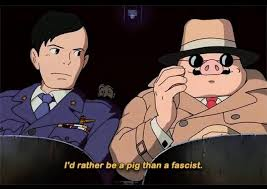
(This image became especially relevant when the White House twitter started posting ai-generated Studio Ghibli styled images)This sort of gave me the impression that the film was some kind of explicitly anti-fascist narrative centered around implicit governmental policies and why they are abhorrent in a way that would be understandable for children. Given the current political climate, I was a bit curious and excited to see how this would play out, but while the film is certainly anti-fascist, it's more of a subtextual theme and backdrop to the rest of the narrative. That's certainly not a bad thing, and I still really liked the film, but sometimes one wants a good excuse to go on an unhinged rant, you know?
Regardless, that quote permeated my mind while watching Porco Rosso, so let's talk about that subtext. The film takes place in a quasi-fantastical Adriatic Sea, just before/during the rise of Mussolini. Our protagonist Porco is a ace pilot bounty-hunter who has inexplicably been cursed to have the face of a pig, and is being hunted down both by air pirates and the Italian state.
Porco's curse, which is never really explained in great detail, appears to be a metaphor for prejudice, the kind that allows fascist states to thrive. Proco is perhaps not literally a pig, but is perceived as swine by the public and the state, possibly for being a political dissident, operating outside of normal society, or being a part of some minority group we are unaware of. Porco is only seen as human by those who have been able to be close enough to see through to his humanity, such as when Gina, who remembers him before his transformation, or Fio who develops a bond to him that allows her to grasp a brief glimpse of his human face. Even the antagonist Curtiss seemingly sees Porco's face after recognizing him as a worthy rival at the end of the film. There's another line that sticks out to me, one where Porco is paying off a loan at the bank and he's asked by the teller if he wants to buy a bond for the people, only for him to respond that "I'm not a person." The literal interpretation here is that Porco is a pig and therefore has no allegiance to humankind, but the underlying implication is that Porco has no intent of supporting a government or country that refuses to see him as human or worthy of rights. In a similar way, that big quote is from a scene where Porco refuses to rejoin the air force, because in his eyes it's better to be seen as sub-human and retain morality than to accept security and societal acceptance in exchange for being complicit or an active participant in horrible actions. Notably, this conversation happens in a theatre displaying a meta-cartoon showing a pig-pilot as the villain.
Another aspect of this film I found very interesting was the 1930's aesthetic of it. You get these really bright colors native to all Ghibli films mixed with some fitting browns and greys representing the gloom of the depression and the industrialization of the 20th century. It's subtle but the way that characters dress in period accurate attire really helps set the mood and make it feel real, even when there's a pig in the room. I read that this film was based on a short manga/illustration book thing that was mainly made to convey Miyazaki's love for old planes, and that really carries over to the film. It's that kind of passion you see from a dedicated fan of a niche interest; shots admiring the movement and details of these flying machines, even if they're more cartoonish in the anime. I really liked that Porco's plane had to be repaired by a big group of women; it shows that during the depression, most women of lower income strata also had to find work, even more so during the war period when all the men went to fight. It's a part of history that I don't see very often in media, so it was cool to see here.
Despite the seriousness of dealing with fascism, the film itself is pretty lighthearted. I rather enjoyed the air-pirates, because despite being villains they really have this goofy and incompetent personality that makes them a lot of fun. Most of them look like Bluto from Popeye, and it's pretty funny to see them get completely stood up to by Fio or overrun by a group of schoolgirls. Porco is never framed as "bad", but as the film goes on you kind begin to understand him a bit more complexly which keeps him compelling throughout the run time. Fio was probably my favorite character; She has a very infectious positive attitude and has a lot of go-getting engineer spunk that makes for a great supporting cast member. I felt like Gina was just ok. Despite being Porco's love interest it didn't feel like she was really there enough or had enough tangible impact on the story to feel like she really needed to be there at all, though she was really offensive enough to have me think she should have been removed either.
Thematically I found the film quite interesting, but for the most part I actually enjoyed it as a simple and fun romp about our hero preparing for the big showdown. It wasn't what I expected, but I still rather enjoyed it. It's perhaps not the most earth-shattering of Ghibli's films, but is still a Ghibli film through and through, and definitely worth your time.

TheRealKyuubey
You Will Believe that a Pig can FlyContinue on AniListIt’s the age of the flying boat, and seaplane pilots of all varieties have descended upon the Adriatic sea, transforming it into a hotbed of piracy and aerial combat. One of the most famous pieces of the infamous Mediterranean sea, The Adriatic is crawling with criminals, and while the general population have plenty to fear from them, the pirates themselves only seem to fear one name: Porco Rosso! Previously known by the name of Marco Pugat, Porco Rosso is a former World War One flying ace who has long since turned in his badge to earn a living as a bounty hunter, quickly becoming the first name you call when there’s trouble brewing over the water. He meets his match, however, in a cocky young American Celebrity who shoots him down, forcing him to go into hiding while he commissions a brand new plane for himself. He now has a limited amount of time to get back into the air, and with his old mechanic friend’s granddaughter in tow, he must rediscover his passion for flying, and also he is a pig.
Before we get into that, though, I’d like to spend a moment talking about the visuals, because hot damn is this a beautiful movie. I know that’s nothing new, Studio Ghibli almost never puts out anything that looks bad... At worst, I thought Earwig and the Witch looked passably okay... But I will state right now, with no hesitation, Porco Rosso might just be the most visually stunning movie they’ve ever made. Released all the way back in 1992, and thus I’m pretty sure not incorporating a single second of CGI, this hand drawn feature contains numerous scenes of pilots flying around both on standby and in combat, meaning these planes had to be hand-drawn throughout every single move and maneuver they made, and so did the backgrounds they were flying against. Sparkling oceans, pristine grasslands, a sea of clouds, immaculately detailed mediterranean cities, all of these backgrounds are constantly moving either with or against the characters in their planes, and it is all realized perfectly.
And again, these are hand drawn planes and backgrounds, not reusable 3D assets. The time and effort that went into all of this had to be insane... I’ve read about one relatively well known animator who was involved with the project, suffered burnout, and was pushed into quitting by Miyazaki himself... And yet the finished project looks as smooth and cohesive as anything you could possibly put out with a computer today. There’s a ton of small, intricate details that are thrown into the animation, like every nook and cranny of the lanes and how they contribute functionally, and all these little movements that the characters make that definitely didn’t need to be added, but noticing them just feels so satisfying, especially when you pick up more with each viewing. A lot of attention was paid to the unique way different characters move, especially regarding Porco and his multiple pig-like qualities, hell, you can even pick up on subtle differences between each of the stock pirate characters.
The animation is consistently smooth, the color palette is bright and eyecatching, unless it wants to be dark and dreary for an appropriate tonal shift. With the exception of a few pirates who do look similar, the character designs are almost all really striking and unique, with the two leads especially being standouts. Fio herself is easily the most fun and personable-looking Ghibli starlet in history, with her enthusiastic expressions, vibrant red hair and working-girl overall with flannels, and Porco himself is about as cool looking as a man with a pig’s head could ever look. My favorite thing about the visuals, however... And I don’t think I’ve seen anyone else ever bring this up, so it might just be a me thing... This movie looks like it was shot like an old school live action American movie. There are so many moments where I found myself thinking “Ooh, I think I know how the director achieved that shot...” Even though it’s an animated movie and everything’s just drawn in.
The English dub was another Disney effort, which is weird, because there really aren’t that many big names in it. They cast a relative unknown to play Fio, as Kimberly Williams Paisley… The wife of the Accidental Racist guy… has always been more of a TV actor. I’ve never seen Father of the Bride, but I guess According to Jim was pretty funny. Every Ghibli movie tends to cast at least one young Hollywood starlet or child actor, and Kimberly’s probably the most obscure of the lot, but to her credit, she plays Fio with all the necessary spunk and enthusiasm. There are a handful of actors who have done other Ghibli projects before... Brad Grret plays several of the pirates, and his loud, deep and dimwitted delivery works perfectly well for them. Susan Eagen returns from Spirited Away, except her character here leans a bit more towards Megara from Hercule with her wistful nostalgia and gentle sultriness.
Carey Elwes played the Baron in both Whisper of the Heart and The Cat Returns, and here, he plays the Texan native Donald Curtis, with an insanely bad Texan accent that I’m pretty sure was the whole point of his casting. This has to be an intentional flip on his comment about Kevin Costner's Robin Hood accent. But the star of the dub, one of the most inspired casting choices Ghibli ever made, was Michael Keaton in the role of Porco Rosso. Yes, Birdman himself... Excuse me, Batman himself... Playing the role of a grizzled veteran haunted by his past, trying to survive in a world that’s actively changing all around him, while occasionally throwing in a snort to remind us of the fucking pig head that we keep forgetting about because we keep getting sucked into his performance, Keaton was perfect fo this role, and he never stops proving it. The adaptive writing occasionally changes lines in the comedic moments, but never the dramatic moments, this is a highly recommendable dub.
On the surface, there isn’t a whole lot to say about Porco Rosso, which isn’t surprising when you find out where it came from. The original story behind it was first printed in a manga by Hayao Miyazaki called The Age of Flying Boats, which he published in a model plane magazine in the eighties. It was a lot shorter than the film, as well as a lot more lighthearted, and mostly served as an outlet for Miyazaki’s musings about the world he wanted to concoct where these little adventures could take place. Realizing his ideas were so much bigger than the world of newsprint could handle, he adapted his own manga into a movie in the early nineties, and it’s really easy to write it off as one of the most fun, well produced and well paced movies of his career, albeit a little on the simple side. It’s a story of good guys fighting bad guys, pirates and daring-do, heroism, and so many awesome aerial battle scenes that you can’t possibly get bored, especially with all of the inanely likeable characters that take up the story. Honestly, all of that alone is enough to justify a recommendation.
The depth to this movie, however, and the elements that will really make you sit down and think, are all involved in some way with Porco Rosso as a character and his development throughout the story. Porco Rosso isn’t just some anthropomorphic swine that’s meant to be a take on the badass loner Han Solo archetype, He goes a lot deeper than that, and the more layers you peel away, the more personal his relationship to creator Hayao Miyazaki becomes. I’m going to get into why this is, which is going to require me getting into some pretty heavy spoilers. Now, if you’ve read my work before, you know I would never spoil anything about an anime, unless I genuinely felt that it wouldn’t harm your enjoyment of the series, or hell, if I thought spoilers might actually enhance the experience in some way, and in the case of Porco Rosso, it’s a little of both. Still, I would never drop a serious spoiler without warning you first, so here’s your warning, spoilers ahead.
Our story, for all intents and purposes, begins during a routine aerial battle, of which Marco was the only survivor. In the aftermath, he has this vision of himself flying among the clouds, watching all of his newly deceased allies and enemies floating up to heaven to join an angelic procession of pilots flying up above, and leaving him behind. He wakes up in the water, transformed into a pig man. Now, being that this is a curse, most characters would be motivated from that point on to figure out how to become human again, but the newly dubbed Porco Rosso seems like he couldn’t be bothered to... But why is this? Well, one of the most important moments in the movie(in my opinion) is a scene taking place in Gina’s bar, where we’re shown a picture of Marco as a human, with his face scratched out, and it was Porco himself who did it. He didn’t do this because it’s a painful reminder of what he lost, but because to him, there’s no difference. He was just as much a pig then as he is now.
For Porco Rosso, the swine face he’s been cursed with isn’t just an external mask, it’s something he’s long since internalized. He sees himself not as a daring hero, but as a selfish, cowardly, treacherous pig. I’m no psychologist, but it doesn’t take Sigmund Freud to realize that Porco has been consumed by depression and self-loathing brought on by survivor’s guilt, and his chosen method of dealing with it is to accept himself as a monster, and be content to live like one. He lives alone, because he believes a monster like him should live alone. He rejects any kind of heroism or altruism because that’s not what a pig would do. He’s resigned to the lifestyle that most closely matches the image he has of himself. You could argue this is one of the better ways to deal with this kind of trauma, as you could neither describe his lifestyle as self-destructive nor inactive, he is living his daily life and making the effort to survive without inconveniencing people, but he is still living in a stasis that’s a shadow of his former self.
When he rebukes people’s expectations by reminding them he’s a pig, he’s not throwing a pity party or digging for sympathy, he’s simply stating a fact, as he sees it. He looks like a pig, because inside, he is a pig, and that belief couldn’t exist unless he also believed that a person’s insides must inherently match their outside, and that’s where Fio comes in. Fio is introduced as his new mechanic, and he immediately rejects her, as she’s both very young and very female, two details he can’t see in a reliable mechanic. He eventually accepts her services after being backed into a corner, and she wastes no time proving his assumptions wrong by showing a genius level aptitude for engineering and a level of potential that hasn't been fully realized yet. He attempts to leave her behind afterwards, only for her to prove herself also just as reliable and devious as he is in their escape from political persecution, so he comes to accept her more and more. At this point you can feel his view slowly changing... If a teenage girl is capable of all this, what about an aging pig man?
When they return to his hideout, she challenges his perception even further by miraculously convincing an entire battalion of lowdown, dirty pirates to show the honor and passion that she’s attributed to seaplane pilots, the same exact honor and passion that Porco considers himself incapable of, so he opens up to her about his past and agrees to fight on her behalf. It’s at this point that Fio passes the baton to Gina, as Porco is struck by the dumbfounding reveal that Gina loves him, but how can that be? How can someone as lovely and wonderful as her ever love a beast? And when she proves it by flying in to interrupt his fight, putting her own safety at risk to warn him of a coming government raid, that proves it to him, and that’s what breaks the curse... His view of himself as a selfish, cowardly pig who nobody could ever love, and deserves only loneliness, is shattered in that moment, as he learns to forgive himself for the past and see his own value again.
Or at least that’s how I see it, there are other interpretations. Now, even with all of that still on the table, you may be asking, okay, but why is he a pig? The movie could have achieved all of this without that element thrown in. He could have just been an old ugly dude who calls himself a pig metaphorically. Well, this is where things get a little more personal with regards to Hayao Miyazaki, because from what I’ve heard from a few sources, he considers this character to be somewhat autobiographical for him. Like, Porco’s journey is reflective of some parts of Miyazaki’s own life. Some evidence to back this up includes the fact that he apparently has a history of drawing pig-like caricatures of himself in his manga... You know, like how the FMA mangaka liked to draw herself as a cow... And Miyazaki is also notorious for being a huge grouch. I don’t know, I mean I don’t know the guy, I’ve never met him... If I did, I think he’d hate my guts, especially if he read my Ponyo review... It is not hard to imagine him having a ton of regrets in his life. Hell, his regrets involving his son Goro alone are probably debilitating enough. Finally, Porco’s political opinions do share a lot of similarities with Miyazaki’s own.
If I had one complaint with this movie, it would be that men tend to fall in love with Fio really quickly... Not only do the stock pirate characters fawn over her, simping pretty hard towards the end, but Donald Curtis proposes to her pretty much the second he meets her, and right after Porco meets her, her grandfather immediately warns him to keep his cloven hooves off of her. This is all despite the fact that she is seventeen, which is slightly uncomfortable for an American viewer, but considering the fact that the age of consent in Italy is fourteen, maybe we should just be grateful the situation wasn’t written any worse. Beyond that, my only other nitpick is that the world this story takes place in can feel a little too nice at times... I mean, I like seeing all of the enemy pilots coexisting in one bar, that’s pretty charming, but for a band of pirates to take a swarm of little girls hostage and not even hit them when they’re out of control feels naive for a story that takes place in the real world, at a real point in history, not in some fantasy realm.
Still, those are just nit picks for a movie I really enjoy, and one that I’d highly recommend checking out. I give Porco Rosso a 9/10.
COMMENTS
0 Comments
SIMILAR ANIMES YOU MAY LIKE
 MOVIE2013, DramaThe Wind Rises
 MOVIE1984, ActionNausicaä of the Valley of the Wind
 MOVIE2011, DramaOjii-san no Lamp
 MOVIE2011, AdventureThe Princess and the Pilot
 MOVIE1986, AdventureCastle in the Sky
 MOVIE2004, AdventureHowl‘s Moving Castle
 MOVIE2001, AdventureSpirited Away
 ONA2020, ActionDrifting Dragons
 MOVIE1989, AdventureKiki's Delivery Service
 ANIME1998, ActionCowboy Bebop
 OVA2014, ActionGargantia on the Verdurous Planet OVA (2014)
 ANIME2013, ActionGargantia on the Verdurous Planet
SCORE
- (3.9/5)
TRAILER
MORE INFO
Ended inJuly 18, 1992
Main Studio Studio Ghibli
Trending Level 1
Favorited by 2,574 Users