

RIKUDO
STATUS
COMPLETE
VOLUMES
23
RELEASE
May 23, 2019
CHAPTERS
241
DESCRIPTION
After losing his father, young Riku Azami encounters Kyosuke Tokorozawa, a former boxer now working as a debt collector. In a world overflowing with injustice, what do people cling to in order to survive? Do they fight?
This is the extraordinary boxing story of Riku Azami as he walks the thorny path of life. The boy has nothing. Nothing but his fists.
(Source: MANGA MILLION)
CAST

Riku Azami

Kyousuke Tokorozawa

Yuki Naeshiro

Kaede Hyoudou

Shinji Baba

Kazuma Tsubaki

Yuichi Mihara
CHAPTERS
REVIEWS

fluent
“What do you seek with those fists, boy?”Continue on AniListReview contains a few spoilers "Rikudou" by Toshimitsu Matsubara is a Dark Seinen manga about the sport of boxing. However, it is more than just a sports manga, as it also takes us through the journey of the main character "Riku Azami" to fulfill a promise he made to himself since young as well as the many obstacles and tragedies in life he has to overcome.
Short summary of the start of the manga:
We start off with the deuteragonist "Kyousuke Tokorozawa", who is a Yakuza member, forcefully breaking open the door of Riku's family's apartment to collect debt. But as the door breaks, Tokorozawa sees a lifeless body hanging, who happens to be Riku's dad. He had taken his own life after being unable to pay off the debts. Furthermore, Tokorozawa is speechless at the sight of little Riku punching his dad's body, saying it's payback for all the times he had been hit and abused by his dad before. Suddenly Tokorozawa punches Riku in the face, resulting in Riku bleeding, and then says that this is what a jab is. Riku is bleeding from his nose but unfazed, and he listens carefully to Tokorozawa's instructions on how to throw a jab. Fast forward, Riku is picked up by his mother and he expresses his desire to live with her, to which she is uninterested but ultimately agrees. Riku then enters the apartment to see a member of the Yakuza injecting himself with a needle, and the mother begs for drugs to use, hinting that she is an addict. Riku shouts at the Yakuza member to stop abusing his mother and the Yakuza rages, trying to kill Riku, however Riku kills the Yakuza member in self defence using the jab punch that Tokorozawa had taught him. The mother is then arrested and Riku is brought to an orphanage. Riku tries adapting to the new enviroment and a teacher "Ehara" helps the boy with all her heart and he starts opening up. But Riku's actions come to haunt him as Riku and Ehara are suddenly kidnapped by Yakuza for killing one of their mates and the teacher is assaulted by one of the Yakuza as Riku watches helplessly full of tears. Tokorozawa ends up saving the both of them and Ehara disappears as Riku vows to become stronger to protect those important to him. He then is brought to a boxing gym from Tokorozawa's former coach "Baba" and his journey starts here."Rikudou" explores multiple themes:
-
Trauma & Abuse from a young age and how it affects a child socially and mentally
-
Moral Ambiguity as most characters in the manga are criminal or corrupt, blurring the lines between right & wrong
-
Self discovery — Riku's journey is not just about becoming stronger, but also about finding meaning beyond his early life trauma and understanding his own emotions and interests
And the one I will elaborate further on:
- Violence as a language and identity
-> From the start of his boxing career, Riku has used Boxing as a means of escaping the world as he spent a lot of time in the gym with Coach Baba to refine his skills and become stronger. He places Boxing as a top priority in his life, leading to him not being a sociable human or being able to communicate well & experience feelings that "normal" humans would. Riku is known and described by those around him as a "Killer", forming an invisible wall between him and the rest of his classmates and peers. Matter of fact, in the first two volumes we see Riku communicate more through physical violence than words. He only knows pain, and that is what he finds in the sport of Boxing: hurting others and being hurt. Boxing becomes an escape from reality and an identity, as Riku once says that he fears becoming "nothing" if he stops improving as a boxer. As Riku's career goes on, he starts learning about things such as emotions and bonds throughout his career fights and slowly starts discovering who he really is & finding out what emotions he really feels. And that is not the case for only Riku, as there are multiple characters in the manga that express their frustrations and wishes through their fists and come to understand things through punches better than with words.
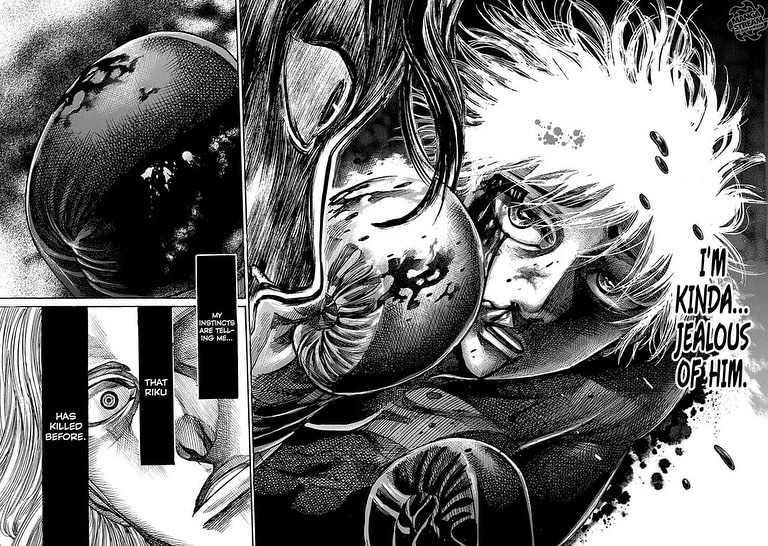
Art:
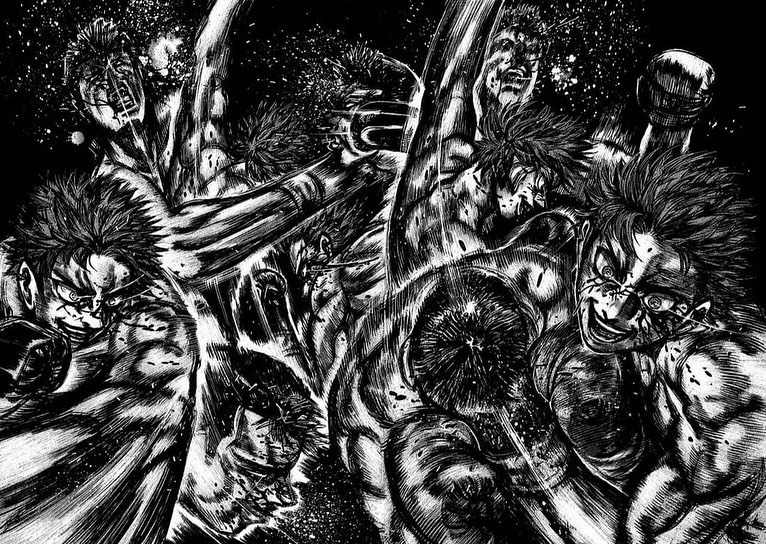
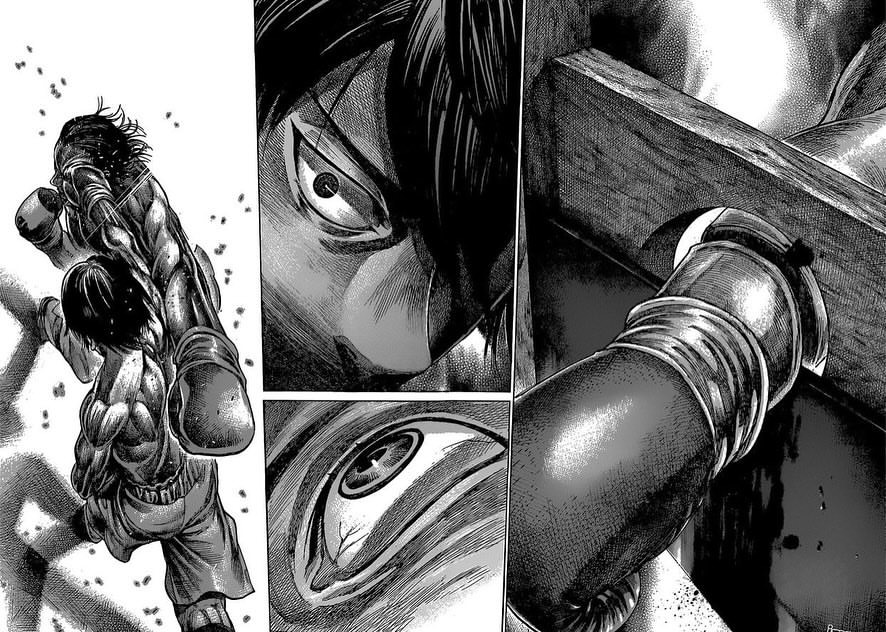
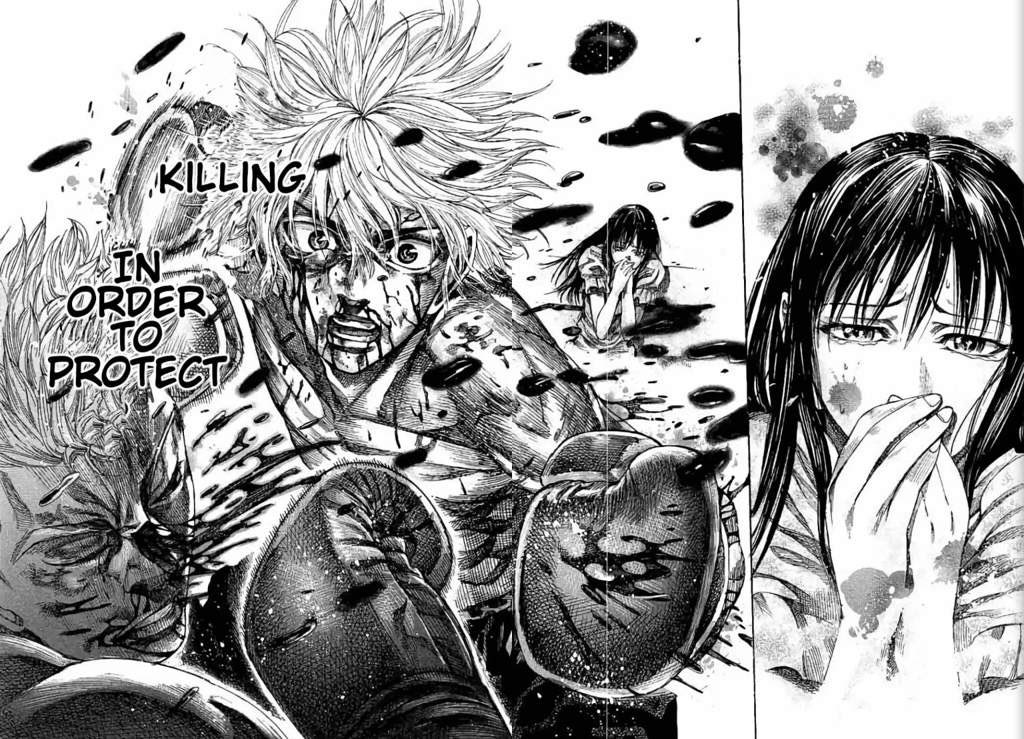
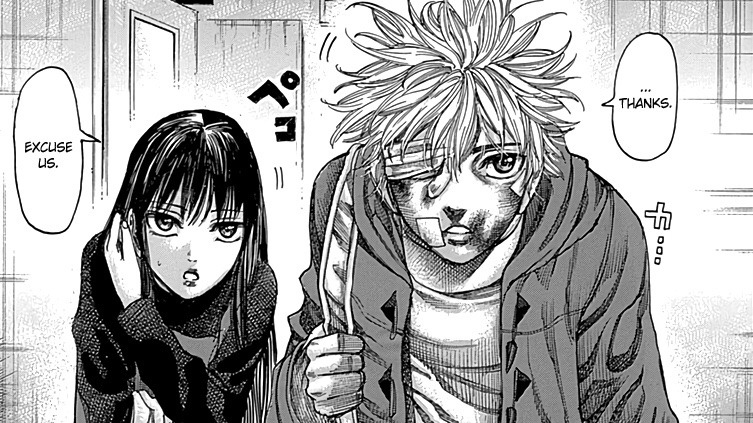
"Rikudou" is one of the best manga when it comes to double-page spreads.
You can feel what the characters are feeling through their facial expressions, and the details to the muscles and enviroment are simply brilliant. I'll show some examples below: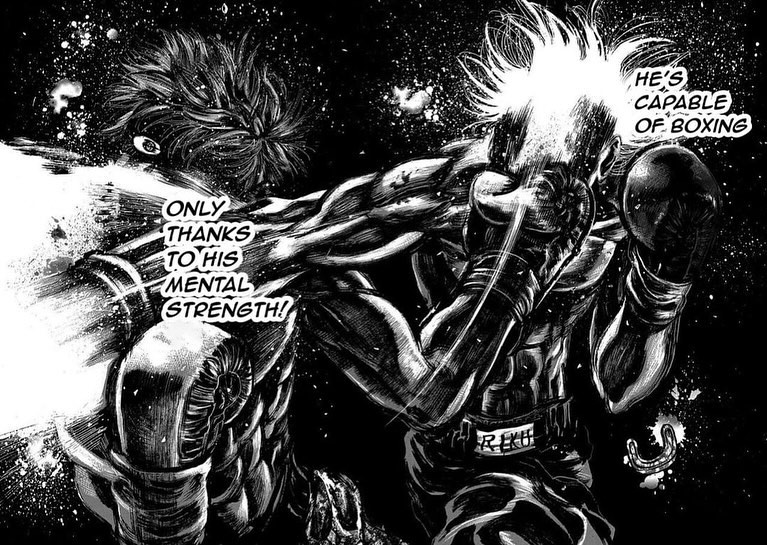
In my opinion, Rikudou is one of the best sports manga out there. It's different in the aspect of being a Dark Seinen opposed to the usual Shounen we see in sports manga. It doesn't just show the protagonist's journey to success in his career, but it reflects on the deep past and trauma of each character. The whole cast is interesting in their own categories and they are all lovable. My favourite characters are: Riku Azami, Seiji Kamishiro, Yuki Naeshiro, Shinji Baba & Yuichi Mihara. I love how close to reality the manga is, as it explores a lot of emotions as well as issues of today such as trauma, lack of emotional understanding, hatred, love, passion, setting priorities, discipline and sacrifice. It also displays that characters cannot easily change, it takes time and effort, which makes it feel more "real". I also LOVE the dynamic and the story between Riku and Yuki and how they live most of their life together, learning to love and understand each other little by little, leading to them realizing how each of them is so important to the other. The fights are pure adrenaline and just so beautifully drawn that it's addicting, so much so that I binged the whole manga in about 3 days.
The only problem that I have is that the ending feels a bit rushed, the author could have taken about 10 additional chapters to make the ending feel "naturally" paced.
All in all, I can say for myself that I really enjoyed reading "Rikudou", and if you are a fan of Seinen sports manga then I definitely recommend this!
-

DragonDelta
The ring doesn't make Riku a champion. It makes him alive. And that's the most heartbreaking thing about him.Continue on AniListThere are sports manga that celebrate glory. That make you raise your fist, that make you want to run, that transform competition into something luminous and exhilarating. And then there is Rikudo, which takes the ring, strips it of all light, and shows you what remains when you remove the glory, the sponsors, the crowds and the dreams of a champion. What remains is Riku. And Riku is frightening, not because he is monstrous, but because he is true.
Rikudo is a visceral and dark work where boxing is not a hobby, not a passion in the romantic sense of the word, not even a dream. It is a biological necessity. A survival reflex as fundamental as breathing. For Riku, his fists are the only language he possesses in a world that has done nothing but try to break him since his earliest childhood. And Toshimitsu Matsubara never lets you forget where that language comes from, what it has cost, what it continues to cost with every round, every training session, every morning Riku wakes up in a world that was not designed for people like him.
The starting point of Rikudo is that of a child the world broke before he had time to understand what life was supposed to be. Riku's childhood is not a narrative backdrop, a convenient trauma placed there to justify his hardness. It is the heart of everything. It is where everything comes from, where everything flows from, and Matsubara takes the time to build that foundation with a rigor and an honesty that make the character unassailable in his coherence. Riku is what he is because he could not have been anything else, and that fatality, that impression that certain destinies are written in inks that cannot be erased, is one of the most disturbing and most powerful things in the entire work.
Rikudo is a masterful exploration of the cycle of violence and social fatality. Matsubara tackles themes of a weight and a complexity rarely seen in sports manga. The devastated family relationships are not treated here as backstory elements you skim past before getting to the fights. They are front and center, they structure every decision, every reaction, every way Riku inhabits the world. The domestic sphere is depicted as the first source of trauma, the place where violence is learned before it is ever exercised, where patterns are carved into flesh and mind with a depth that years and victories are not enough to erase. Matsubara shows something true and difficult to look at directly : violence is not born in rings. It is born in homes, in silences, in blows received before you have learned to give them. And the ring, for Riku, is the place where that violence finally finds a framework, rules, an adversary who deserves it.
The bond between Riku and his mentor is one of the richest and most complex axes of the work. It is not a simple relationship, not the one of the benevolent master and the grateful student found in so many sports manga. It is something far more twisted, far more painful, a relationship that carries within it the original drama of Riku's life, that is simultaneously an attempt at repair and a perpetuation of the wound. The mentor is tied to what Riku experienced, and that connection makes the ring the only place where Riku can truly confront his demons, not by overcoming them in a heroic surge, but by looking them in the face, letting them hit him, choosing to remain standing despite everything. It is brutal and incomplete therapy, but it is the only kind that exists for someone like Riku.
And that is where Rikudo joins, in its deepest philosophy, another great work of sports manga : Ascension. Like Buntarou facing his summits, Riku undergoes a total alienation where the world outside his discipline eventually ceases to exist. He places absolutely everything else in his life on the back burner, family, comfort, social normality, ordinary human relationships, in favor of an obsession that consumes him entirely. That parallel is not superficial. In both cases, you are dealing with a protagonist whose passion is not a liberating choice but a consented prison, a way of fleeing what cannot be faced by any other means than self-destruction. The difference is that where Buntarou seeks the purity and silence of the summits, Riku seeks the pain and noise of the ring. Two different ways of losing yourself in the same direction, toward something absolute that justifies everything else.
The art of Toshimitsu Matsubara is a declaration of pain and movement. His line work is powerful, loaded, at times almost brutal in the way it fills the page. He captures the impact of punches with a physical precision that makes you feel the shock in your own body, the deformation of faces under the force of impacts, the way a human body absorbs and yields and gets back up and absorbs again. There is no aesthetic glory in these panels, no elegant choreography, no heroic poses frozen in artificial beauty. There is sweat, blood, pain, and a physical truth about what boxing really is when you strip away everything the spectacle has added to it. It is a dirty boxing manga, and Matsubara draws it with a macabre beauty that is his most immediately recognizable signature.
But Matsubara's art does not limit itself to fight scenes. His panels of the slums, the miserable apartments, the lightless streets where Riku grew up and survived, have a darkness and a density that anchor the story in a concrete and oppressive social reality. You feel the weight of the environment on the characters, the way places shape the people who inhabit them, the way material misery and emotional misery feed each other to produce beings who never had any choice but to harden or disappear. Matsubara draws poverty not as a picturesque backdrop but as a condition that determines, that limits, that confines, and that social dimension gives Rikudo a depth that distinguishes it radically from the majority of sports manga.
The fights in Rikudo are among the most intense and most unsettling in the genre, precisely because they are never simply fights. Every confrontation is a negotiation with the past, a way for Riku to answer questions that everyday life does not allow him to ask. Victory never tastes like glory in these pages. It tastes like blood, like exhaustion, like the relief of still being standing, like the sharp awareness that next time will be even harder. And defeat is never simply a sporting defeat. It is a questioning of everything Riku has built on the only foundation he has left. That way of loading every fight with a significance that goes far beyond the simple sporting result is what makes Rikudo a manga of exceptional emotional and narrative density.
Redemption in Rikudo is not a promise. It is a question. And Matsubara has the honesty and the courage to never answer it definitively. The only redemption available to Riku lies in endurance and physical suffering, in that capacity to absorb what the world inflicts on him and remain standing, not through heroism, not through nobility of soul, but through pure obstinacy, through a visceral refusal to be definitively broken. It is an incomplete, unsteady redemption that does not repair what has been shattered. But it is the only honest one, and in this manga, honesty is worth more than any neatly packaged catharsis.
Rikudo stands alongside Slam Dunk and Ascension at the peak of what sports manga can achieve when it decides not to settle for celebrating performance but to explore what performance costs the one who makes it the center of their existence. It is a work that does not leave you unscathed, that does not seek to leave you unscathed, and that proves the ring can be both a slaughterhouse and a sanctuary, a place of destruction and the only place where certain human beings finally find something that resembles a reason to exist.
10/10.
COMMENTS
0 Comments
SIMILAR MANGAS YOU MAY LIKE
 MANGA ActionBlack Iron Einheri
 MANGA ActionAll-Rounder Meguru
 MANGA ActionRokudenashi BLUES
SCORE
- (3.9/5)
MORE INFO
Ended inMay 23, 2019
Favorited by 379 Users