

POKÉMON THE MOVIE 2000
MOVIE
Dubbed
SOURCE
VIDEO GAME
RELEASE
July 17, 1999
LENGTH
81 min
DESCRIPTION
A greedy collector, Lawrence III, wants to capture the legendary Pokémon, Lugia. But in order to do so, he must capture the Titans of Fire, Ice, and Lightning. The titans are powerful bird-like Pokémon, and if they are disturbed they will wage a war against eachother which will ultimately result in earth's destruction. Ash, Misty, and Tracey get caught up in the situation when they end up being washed ashore onto Shamouti Island. Soon after, Ash meets a girl named Melody who sends him into a mission where he must collect the 3 Orbs which will quell the fighting, but first Ash must gain help from the Beast of the Sea, Lugia, if he's to succeed.
(Source: Anime News Network)
CAST

Satoshi

Rica Matsumoto

Pikachu

Ikue Ootani

Kasumi

Mayumi Iizuka

Lugia
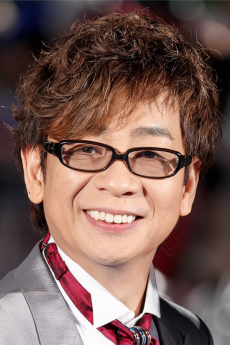
Kouichi Yamadera

Kenji
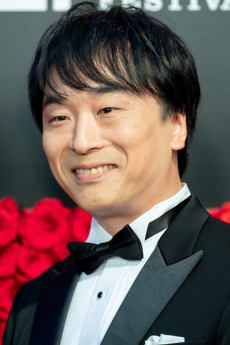
Tomokazu Seki

Gelardan

Takeshi Kaga

Narrator

Unshou Ishizuka

Kojirou
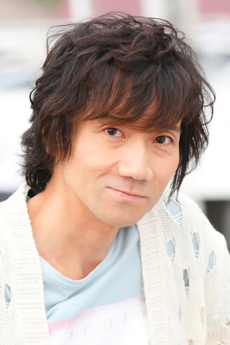
Shinichirou Miki

Musashi

Megumi Hayashibara

Takeshi
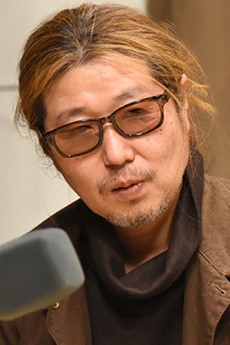
Yuuji Ueda

Nyarth

Inuko Inuyama

Togepy

Satomi Koorogi

Yukinari Ookido
Unshou Ishizuka

Hanako

Veronica Taylor

Uchikido Hakase

Keiko Han

Flura

Akiko Hiramatsu

Yadoking

Masatoshi Hamada

Michiko

Kotono Mitsuishi

Yodel

Aya Hisakawa
Episodes are being prepared. Check back soon.
RELATED TO POKÉMON THE MOVIE 2000

 SPECIAL FantasyYadoking no Ichinichi

REVIEWS

TheRealKyuubey
Better than the first one, but that's not a very high bar.Continue on AniListThe world of Pokemon can be a strange, wonderful, and often terrifying place. Along with humans and a select few diminutive and unimpressive animals, this world is inhabited by a race of peculiar creatures known as, of course, Pokemon. These creatures come in all shapes and sizes, from tiny moles and worms to giant whales and rock-snakes, and while some of the smaller ones might make good pets, almost all of them are capable of devastating feats. It’s understandable that some people may give Pokemon a wide berth, avoiding them at all costs, but there are a few brave souls among us who dare to encounter them up close and personal on a regular basis, bettering themselves in order to overcome any obstacle the world’s Pokemon might put forth. We call them Pokemon Trainers, and the very best among them, who’ve captured or at least owned one sample out of every known Pokemon, are considered Pokemon Masters! Of course, realistically, there can only be one Pokemon Master, as a select few Pokemon are one-of-a-kind, and capturing just one of them destroys the chances for anyone else to achieve said accolade. Seriously, what’s up with that?
Among these unique creatures are the legendary birds, Articuno, Zapdos, and Moltres. These Titans of unimaginable elemental power live on a series of islands near Shamouti in the Orange Islands region, engaged in an ancient stalemate over their territory, unknowingly guarding the dormant beast of the sea. Should any one of those three be captured and removed from the scenario, that beast will roar to life and throw the world into chaos. This legend has attracted the attention of Lawrence III, a Pokemon collector with a hunger for the rare and valuable. Using his incredible technology, he has every intention of capturing these titans in order to lure out the beast of the sea… Who he believes to be the legendary Lugia. Unfortunately for him, an old prophecy states that when the balance of power taming the beast becomes perturbed, a chosen one can step in and make things right again! And as it just so happens, Ash Ketchum and his friends are passing through the area on the way to their next Orange Islands gym battle, when they wind up getting dragged into the conflict. When the world turns to ash, will one of these brave souls step up and take the world’s fate into their own hands? Or will humanity become the next one-of-a-kind species?

Remember in my review of the first movie, how I said it struck the right balance between CG and 2D animation, and that the balance would get progressively worse with each passing movie? This is where it starts, and oh boy does it get off to a noticeable start. Right off the bat, we’re shown Lawrence’s Castle in the Sky, a giant floating base somehow kept in the air by slowly turning propellers. If this movie had come out a few years later, it would probably be paired with Feel Good Inc as it’s pop song BGM. Anyway, this thing is the most obvious, out of place computer-generated construct since the tongue beasts in the first Resident Evil movie, and two dimensional characters appearing in the same shot look about as real and natural as paper dolls taped to a very expensive child’s toy. It’s also pretty obvious how much money went into this thing, because about half of this movie’s animation is about as low quality as the show, with talking heads moving and freezing on still canvases, and barely any background movement in shots that have lots of people on them.
If that’s not bad enough, there’s a scene very early on where the team is traveling by boat, and they’re hit by a storm that causes some turbulence. There is a shot where Pikachu is standing nervously on the rocking boat in a close-up, and I swear to Arceus they just took the still image and shook it around to give the illusion of movement. Characters often seem to freeze into the background whenever they’re not talking, some of the scenes are very poorly shot(like Ash’s arrival on Shamouti), and a lot of the movie is distinctly out of frame, due to 4Kids’ decision to convert the film from widescreen to fullscreen. Another obvious CG effect is an entirely pointless scene where hoards of Pokemon are stuck on an ice sheet staring out into the water, but can still be seen moving from a mile away, including Kangaskhan doing her little sumo stomp. The only moments where the CG and 2D elements blend nicely to the tune of a decent budget, and thus the moments that differentiate it from future movies, are the action scenes, most notably when the legendary birds are fighting either Lawrence’s devices, each other, or both. The animation for these moments are breathtaking, fast paced, and over-all a joy to watch, to the point that I’d actually say it’s worth sitting through the rest of the movie’s animation to get there.
The music, however, is a step up from the first movie. The score is powerful and epic, particularly with the music that accompanies the action set pieces. Rather than a Danny Elfman sound, like the first movie utilized, this one has more of a John Williams sound, which is equally appropriate. Where the first film had a dark and ominous tone, this one plays out more like a grand, sweeping adventure, so the music has to be a lot bolder and, well, for lack of a better term, bigger. This does unfortunately result in a lot of the tunes sounding a bit homogenized, but that’s not necessarily a bad thing, as this type of movie kind of calls for it. It only tends to get annoying when it comes to what I can only describe as the musical motif of the film, a certain wind tune that a new female character introduces us to. She never states what she’s playing, and I can’t identify it by ear, so we’ll just call it an Ocarina. It’s important to the plot, so I can’t harp on it too much, but suffice to say it gets old pretty quick. Thankfully, with Lugia’s Song as an example, it rarely ever plays in the background without evolving into something far more awesome.
The soundtrack in this movie is nowhere near as embarrassing as the first one, as it seems to have been put together with a much better focus than it’s pop-song grabbing predecessor. The Ocarina motif that I mentioned before gets expanded into a full song by Donna Summer, which was based off of one of this movie’s three names, The Power of One. It’s a pretty great song, not gonna lie, but it’s very nature carries one of the most unfortunate problems with the english version of the movie, which I’ll get to later. The pop version of Pokemon World is also pretty awesome, even though it’s being sung by two nineties bands that haven’t been mentioned by living people for over ten years. Yeah, the song itself is fun, but it only really becomes cringeworthy if you watch the two bands performing it onstage, which is totally a thing on the DVD extras. Those poor teen bastards. Even the actors from Pokemon Live came away more dignity than that. Flying Without Wings by Westlife is a pretty decent song… well, at least the cut the movie used… And for a bit of unexpected weirdness, Weird Al actually pops up in the credits to combine the Pokerap with his own Polka trend.
It’s not what I’d call a perfect soundtrack, but at least they tried to keep things relevant this time around. But much like the first movie, there are tunes on the CD that didn’t make it into the movie… Dreams by Alysha Antonino has the makings of a pretty good song, but the production features the absolute worst flavor of the late nineties. The lyrics themselves are almost poignant in their message, but the orchestration is just butt ugly. The Extra Mile by Laura Pausini is really generic, and could easily be placed in the credits of almost any film without feeling out of place. I hate to get mean over a song that’s been lost in time, but when I buy a CD and load the songs to Itunes, this is the kind of song I leave off. The same could be said by One Heart by O-Town, which probably the most memorable forgotten band in existence, and With All Your Heart by Plus One. The only songs present that are as entertainingly bad as the last CD are Chosen One by The B-52s, which almost seems to be making fun of the movie’s prophecy, and They Just Don’t Understand, a song by a bunch of twelve year olds called Dream Street about their love of the franchise. This one also appears on the DVD in all it’s cringey glory, you’re welcome.
For the most part, there isn’t much I can say about the english dub without talking about the series, as the acting in this movie is pretty much the same as the series at it’s best. I’ve always felt that the acting was the best part of the 4Kids dub, with the writing always being more hit-or-miss, heavy emphasis on the miss. I will concede that Ed Paul as Tracey is slightly less annoying than Eric Stuart as Brock. That, and while it might just be my imagination, Addie Blaustein was putting forth a bit more effort than usual as Meowth. Another performance of note comes from Veronica Taylor, who we’ve all gotten used to hearing as Ash, but also gets to play Ash’s mother in this film, and she gets a really heartfelt exchange with him later in the movie. Eric Rath was a bit on the forgettable side in his turn as Lugia, and despite having just as little voice acting experience, Neil Stewart was quite a bit better as Lawrence. Nathan Price, who’s done a bit more than those two, does a great job as Slowking, making the character sound like a slow, dim-witted person who’s somehow come upon great intelligence but still speaks like he used to.
The worst thing about this dub are the changes it made to the material, of which there are far too many. There was at least one plot point that I hoped was a rewrite, but no, it wasn’t… The rewrites that do exist are way worse. The relationship between the Legendary Birds and the Beast of the Sea is given a much better explanation in the Japanese, although it’s still a work of fantasy, so it’s not THAT much better. There was originally a moment when Tracey was allowed to shine by helping his friends to science their way out of a jam, but that got cut, so he’s basically as useless as his Venonat was in the opening short. Much worse than these, and probably much more shocking to westerners who’ve never seen both versions, is the fact that the whole “Power of One” idea was entirely a dub-only concept. In the Japanese, not only was there no such thing as a ‘chosen one,’ but from what I’ve been told, there was no prophecy, either. The film actually had a heavy emphasis on teamwork, which makes more sense considering how much help Ash needs throughout. Much like the pacifism of the first movie, this just goes to show how confused 4Kids can get when it comes to teaching western-friendly morals. If you can, stick to the sub.
If you knew me around the turn of the century, you’d know that I was a huge Pokemon fanatic. If you were also a member of the Pokemon fandom, you probably also knew that I was a huge fan of the Orange Islands arc. To this day, it’s still my favorite season of the original series, and the only season that I own on DVD. It was just so different from anything that came before, or that’s come out of the series since. As far as I’m aware, it was the only season to not be connected to the games, although I did at least attempt to run the fan-made Pokemon Orange-version on my piece of crap MacIntosh. I loved how much creative freedom it had, as it wasn’t tied down to the formula of the Kanto region, as they didn’t have to dedicate each episode to revealing a new Pokemon, and they could just write episodes revolving around new concepts of older, already established Pokemon. Some very popular iconic Pokemon got to take center stage, like Lapras and Snorlax, and the battles didn’t have to be actual battles, and there was a lot more material for Pokeshippers. It was a breath of fresh air, and the news of an upcoming movie finally got my ass into theaters.
So how did it hold up? Well, you hardly need me to tell you how popular it is. While the critics were notoriously tough on it, giving it only a one point advantage over it’s predecessor, it is one of the most common fan favorites among the actual Pokemon fandom. It’s lowest review score on Myanimelist is a 6(until now), and none of those reviews lasted more than a single page(until now). It’s not hard to see why, because this was the first Pokemon movie to feel like an actual movie. It had a more epic, theatrical feel to it, with higher stakes and arguably a more ambitious story than most other Pokemon films. It introduced two Generation 2 Pokemon, not counting Elekid in the opening short, and the ones it did introduce in the main story were actually important to the plot, not cannon fodder in a random opening battle. It’s not often considered the best movie in the Pokemon line-up, that honor often goes to the Entei and Lucario movies, but it is a generally respected and highly regarded movie… Which is why it might surprise you to hear me say that it really isn’t THAT much better than the first film.
Now, credit where credit is due, it does a much better job following the traditional three act structure. In the first act, we meet the villain. We learn about who he is, what his plan is, and what will happen if said plan comes to fruition. We also get introduced to the main character, why he’s in the area, and how he gets drawn into the conflict. We get all the backstory we need, and then some, as well as intros of basically every single plot point that’s going to matter. In the second act, the plot picks up, and we see the main character set out to resolve the conflict as quickly as possible, even though the conflict is way bigger and more dangerous than he initially thought, and his inability to solve the problem leads him into a worsening situation, where things basically hit rock bottom. Finally, in the third act, the worst case scenario happens, the main makes a much grander stand, and it all builds to a climax that delivers on everything that set it up. Power of One follows the three act structure so well that it’s almost like the writers made a conscious effort to do so, and it’s ultimately the reason that the movie feels so much more like, well, a movie.
Having said that, a three act structure doesn’t guarantee the movie will be good, and for all of it’s grandeur and epic nature, this movie has just as much stupid, lore and continuity breaking material in it as the last one. First of all, harping on the English dub, the prophecy is completely pointless. Not only does it feel mind-numbingly stupid that some ancient prophecy knows who Ash is and decides that only he, one of the most incompetent heroes in anime history, can possibly set the world back to right, but there was nothing in the prophecy about Lawrence starting all of this conflict. It also doesn’t work in terms of the story, because Ash doesn’t need a prophecy to tell him to go into action and save the world… He’s a good person, he’ll do it anyway! Hell, I wouldn’t even make that point if it wasn’t for the fact that (mild spoilers in this sentence) Team Rocket, the show’s signature antagonists, decide all on their own to turn over a new leaf and act heroic for the sake of saving the planet. Ash needed a prophecy to call him out by name(In an oh so clever pun that fooled absolutely nobody), but Team Rocket are the altruists in the scenario? Bull to the motherfucking shit!
Going right back to act one, not only does Lawrence have a Pokemon trading card… Which just throws all kinds of logic out the window, because this isn’t Digimon Tamers we’re watching… But the exposition he gets from his computer makes no sense. It identifies the prophecized Titans as the legendary birds, which means he likely didn’t know that yet, and since the prophecy mentioned nothing about Shamouti, how the hell is he already in the area? And why are Ash and friends taking a ferry, when they usually just ride on Lapras’s back? It would make sense in a Pokemon game, but they never had random encounters on her back before. Also, how did Lawrence and Ash move into position on the exact annual day that the island was expecting this exact catastrophe to occur? Then in the second act, we get such gems as Tracey being useless, a flying sailboat, Ash trying to tackle an electrified cage, and to top it all off, there’s a strong implication that in order to catch all existing Pokemon… Or to “Catch’em All,” which is explicitly the catch phrase of the series, you would have to destroy the world as we know it in the process. I don’t think they really thought this through.
Then the third act happens, and I can’t believe I’m saying this, but it damn near justifies everything. In the first movie, the “third act,” if you could call it that, is where it failed hardest, as it used it’s climax to crawl right up inside it’s own ass. This, however, is what a third act is supposed to be. Every single plot point, even the worst ones like Misty bantering with Melody over her crush on Ash, comes to a satisfying conclusion. Even though there’s well-animated action scenes throughout the movie, this part of the story upstages all of them, as it should, with Lawrence being largely written out of the story so the birds themselves can fight among themselves, and it’s as awesome as it sounds. That’s not to say nothing stupid happens… Bulbasaur and Squirtle are shown to run as fast as Charizard flies, in a scenario when he really should have tried to call out Lapras, and the dialogue between Melody and Misty ends in an exchange that doesn’t make much sense… I’m assuming only one person in that group has any idea how to play the Ocarina… But it doesn’t matter, because every moment leads to something great. Does that make all the stupid crap that we had to sit through to get to that point okay? No, not really, but at least there’s something at the end worth sitting through it all for. It’s not much, but it’s something.

Pokemon the movie 2000, also known as The Power of One and Revelation Lugia, is available from Viz Media in both single format and a three-pack with the first and third films. . You can also find the out of print original DVD from Warner Home Video, albeit at a much more expensive price. Unlike the first movie, you can also find the soundtrack and score on the same CD, although brand new copies are quite a bit more expensive. Netflix generally has about four or five different Pokemon movies available for legal streaming at any given time, and this is occasionally one of them.
Despite my criticisms, this is my favorite Pokemon movie, and it’s the one I have the most nostalgic feelings for. There are at least two scenes in it that make me cry… One involving Team Rocket, the other involving Ash’s mom… And that’s something no other Pokemon movie can say. It also expands upon the lore in a lot of interesting ways, such as giving a few characters first names for the first time. Of course, just because it’s my personal favorite doesn’t make it one of the best ones. I wouldn’t even call it one of the top five. Looked at as a sequel, it just barely surpasses the first movie in terms of scale and execution, but the story is still based on coincidence, there’s still a lot of dumb and inaccurate material, and it breaks the fourth wall more than any Pokemon movie should. It doesn’t fall into the trap of pushing a confused and hypocritical moral, but it only pulls this off by not trying to push ANY moral… Which is probably the smart way to go, but it still doesn’t convey the kind of growth that a sequel should go through. It’s sense of pacing, structure and emotional resonance, as well as it’s killer third act ultimately saves it, but doesn’t vindicate it. I give Pokemon the Movie 2000 a 5/10.

AkaiShitoHat
From identity to coexistence: the second chapter of Takeshi Shudo's philosophical vision of Pokémon.Continue on AniListPokémon Movie 02 – The Symphony of Coexistence Following the remarkable success of Mewtwo no Gyakushuu, Takeshi Shudo was commissioned to create the franchise’s second feature film, with the obvious and pressing expectation of replicating that commercial triumph. Although this new installment presents itself as a lighter and more adventurous action film, it remains in substantial thematic continuity with its predecessor. Rather than continuing Mewtwo’s conceptual core in a strict sense – which, according to the author himself, could not yet be considered complete – it explores its natural next step. If the first film revolved around the concept of self-affirmation and questioning one’s own existence, the next stage, according to Shudo, *consisted of exploring whether individual identities, once self-awareness had been attained, were capable of coexisting*. On this matter, Shudo himself states: >**“I was firmly convinced that, although the second feature film had to take the form of an enjoyable action-adventure, it was impossible to ignore the theme introduced in the previous chapter in order to make room for a superficial adventure existing solely for its own sake [...]. I felt that, within the framework of a cinematic saga, I could not allow myself to reset its thematic continuity.**”
The second feature film was also conceived with “the intention of evoking the atmosphere of the great action-adventures of the past” and, as such, was structured in a lighter fashion, allowing the viewer to be carried along by the fast-paced rhythm of the protagonists’ journey. Nevertheless, we should not forget that the previous chapter rested entirely upon the profound existential question, *“Who am I?”*, and it is precisely for this reason that I intend to undertake the same exegetical exercise I carried out with its predecessor, in order to examine it as thoroughly as my abilities allow. In doing so, I will rely primarily on the writings of Takeshi Shudo, the author of its screenplay. This review contains spoilers; if you want to watch the original movie, viewer discretion is advised. ___________________
**Beyond Identity** As partially anticipated, the explicit request from the production staff for this second film was diametrically opposed to that of its predecessor: they no longer wanted to hear about “tedious themes” such as the search for the self, but instead demanded an action-adventure that would be light-hearted, fresh, and enjoyable.
The company's second directive concerned the film's title: a rather influential executive insisted that the term “**爆誕**” (_bakutan_, meaning “explosive birth”) be included in it. In reality, this was a word that did not exist, being entirely absent from Japanese dictionaries and, most likely, a neologism coined by the executive himself. Evidently, to him and many other members of the staff, it represented a modern, impactful, and catchy expression. The only problem was that the term had little to do with the plot itself: within the narrative there is no birth whatsoever (in the strict sense), whereas the term bakutan clearly evokes the idea of an entity coming into existence as the result of an explosion. With hindsight, one could argue that the executive's idea ultimately worked, since the term was later officially incorporated into Japanese dictionaries.
Returning to the previous memento, according to which the first film revolves around the question “Who am I?”, it is possible to perceive, within the deepest recesses of the second film's narrative, a subtle echo that serves as an answer to that very question. Faced with the question “**Who am I?**”, the answer lies in the affirmation: “**I am myself, and I am no one other than me.**” Indeed, if we think about it, the entire crisis that threatens to destroy the world begins the moment the delicate balance (coexistence) among the three Legendary Birds is disrupted. Conversely, the planet's stability is restored only when each entity reclaims its own space (its respective island) and its true nature (its personal identity).
One could therefore draw a comparison with a great orchestral symphony: insofar as each individual commits to playing the instrument that bears their own name, without forcing themselves and while giving their very best, their personal melody will remain unbroken, and the surrounding world will preserve its harmony and equilibrium. Nor is it a coincidence that the musical dimension plays a key role within the film (the flute melody played by Frula (Melody), intended to calm the three deities).
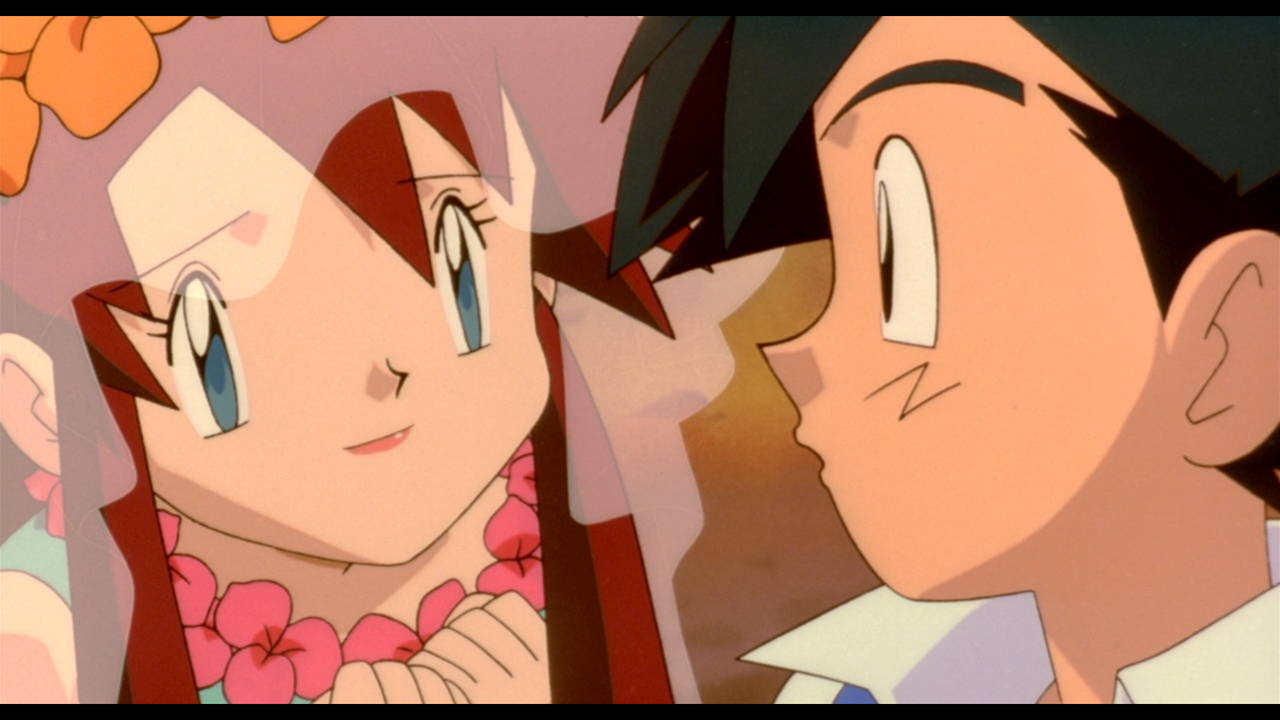
This opening discussion allows me to introduce the central theme of the second film: coexistence. ______________
**Coexistence Through Self-Affirmation** The Power of One turns its gaze toward the coexistence (in Japanese, “**共存**” / _kyōson_) of all creatures inhabiting the Earth. The definition of the term commonly found through a search is the following: “*the simultaneous presence or existence of multiple elements (phenomena, groups, species, or systems) in the same place or at the same time*”. However, Shudo’s conception of coexistence is profoundly different: >“**To me, coexistence means respecting one’s deepest identity, living life exactly as one wishes, and only afterward realizing that other beings (or life forms) are also spending their existence alongside us.**”
He therefore conceives it in a way that is almost the opposite of the image that would normally spring to mind whenever we evoke such a concept; an invitation not to be self-centered, to reflect upon the feelings and position of others in order to live together in harmony and peace. This conception stems from one of the author’s own reflections: >“**[…] However, one must ask oneself: can forcing oneself to suppress one’s identity – that existential uniqueness which each of us represents in this world – simply to make room for others and facilitate coexistence truly be defined as ‘genuine coexistence’?**”
This is why, according to Shudo, true coexistence is realized only when each individual vigorously affirms their own presence and, in doing so, discovers that others are doing exactly the same thing within the very same living space. The intention, therefore, was to convey the idea that each of us is a _unique and irreplaceable being_; to explore the relationship between oneself and others, and the kind of world that this process tends to create. The awareness that differences exist between ourselves and others, whose existence we nonetheless respect.
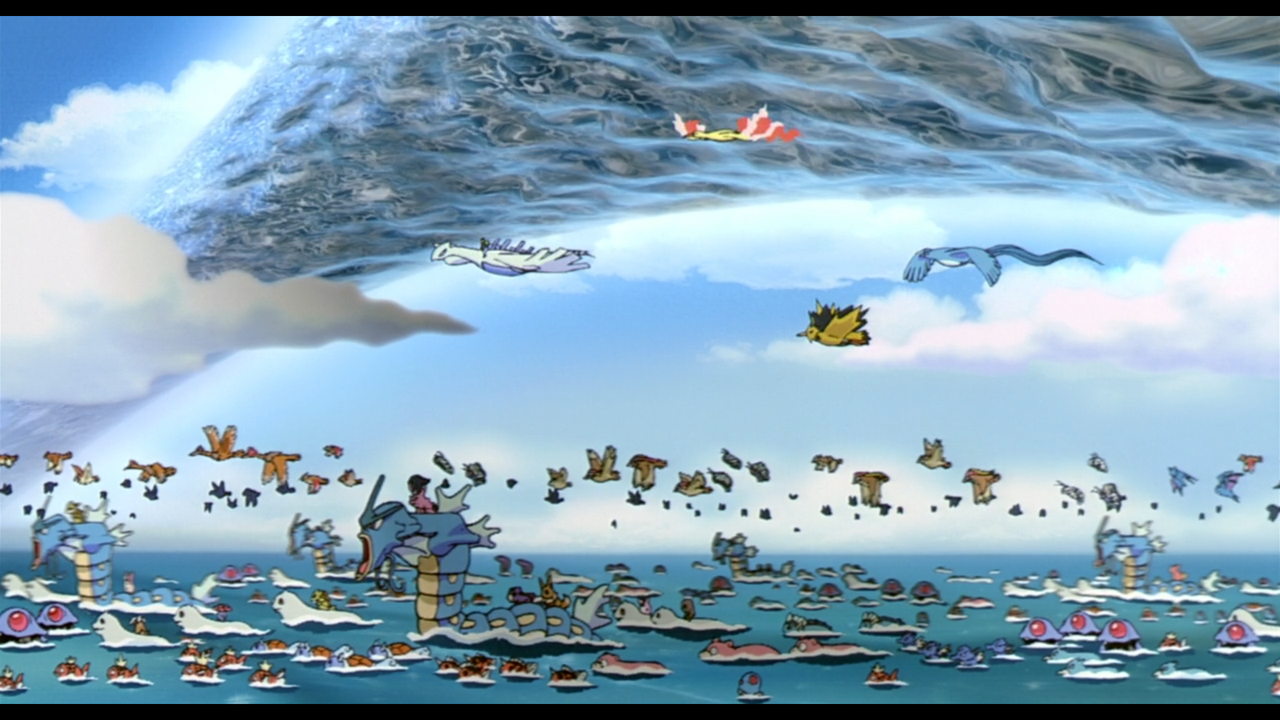
It is a strongly individualistic conception, born from the notion that without ourselves, our world would not exist. >“**At the center of the world stands the individual. If I were to vanish, my entire universe would cease to exist; and a world in which I am absent cannot be defined as my world. It would be a foreign reality, entirely disconnected from me [...]. Every human being is a distinct entity unto themselves. No person is identical to another. Consequently, even the scale of values we assign to our own existence is unique [...].” “One often hears the maxim: ‘Do not delude yourself into thinking that the world revolves around you.’ And yet, since my death will bring about the end of my entire universe, would it not be more accurate to affirm the exact opposite? Namely, that the world, after all, truly does revolve around me?**”
And this reality, composed of interpersonal relationships, would according to the author cease to exist with death itself, since the life of every creature is confined within a limited span of time. >“**With death, the universe of that individual reaches its terminus. Whether future generations choose to glorify the value of the deceased or tarnish their memory, all of that loses any meaning for the one who has died [...]. The moment death arrives, everything dissolves into nothingness.**”
How, then, does the connection between the two principal themes of the respective films manifest itself? __It manifests in the sense that the first – self-existence – serves as a prerequisite for the second – coexistence. __Precisely because the former is the foundation upon which the life of the individual rests. Only through sufficient self-awareness is it possible to “bloom in life” and, consequently, fulfill that supreme ideal of living which, according to Shudo, consists of “doing everything one wishes, following one’s whims within the limits of one’s material possibilities.” Having established all of this, the author believes that genuine coexistence between individuals in the real world would, in practice, be unattainable; nothing more than an illusion. Regarding this matter, he states: >“**[…] If everyone pushes their self-affirmation to its utmost extreme, the commonly understood concept of coexistence becomes unworkable [...]. I do not possess such unwavering faith in the possibility of a perfectly balanced coexistence among different personal identities.” “[...] Such a dynamic is, in reality, impossible. There are no two identical human beings on Earth, nor two creatures bearing the same existential imprint. The moment each individual decides to give free rein to their self-affirmation, a collision with the demands of others becomes inevitable.**”
In the Pokémon world, however, things are different: the author had already explored this theme in the first film, granting his characters the possibility of understanding and processing it. They therefore possess the necessary “prerequisite” for coexistence among living beings.
The core of The Power of One’s action-adventure narrative lies precisely in its attempt to make a group of characters, each driven by this strong and individualistic urge toward self-affirmation, engage with the theme of coexistence. Among them, the characters who stand out the most are the Team Rocket trio – Jessie, James, and Meowth – who were characterized in this manner from the very beginning. Shudo structured even the television series so that their individual identities as people would always take precedence over their affiliation with Team Rocket itself (where recruits are essentially interchangeable and indistinguishable from one another). Even their uniforms reflect this anomaly (white rather than black). Their iconic introductory motto also embodies this aspect of their character: in essence, it is as though they were shouting to the audience, “We are not ordinary members of Team Rocket... before anything else, we are Jessie, James, and Meowth!”
Upon reflection, this is an extraordinarily forceful act of self-affirmation. Although this nuance would become increasingly pronounced as the series progressed, before eventually being sacrificed upon the altar of cliché, Shudo originally granted their voice actors almost complete freedom to improvise, allowing them to deviate from the script. Unlike the protagonists, who by virtue of their role were forced to operate within rigid and predefined boundaries, they were free, original figures. And it is precisely by embracing this spirit of defiance that Shudo chose to write the screenplay of the second film, structuring it in part around the Team Rocket trio.
Returning to our discussion of coexistence, it is in this light that the two fundamental scenes in which this theme is explored most prominently should be interpreted. The first is the conversation between Ash and Lugia, during which the latter speaks of how everyone possesses their own world, and how those worlds must be preserved. The second – and, in my opinion, the most important – is the concluding scene in which Delia scolds her son for the recklessness he displayed while attempting to save the world: >“**If you had died, your world would be gone. My son would be gone. The world exists only because you are here.**”
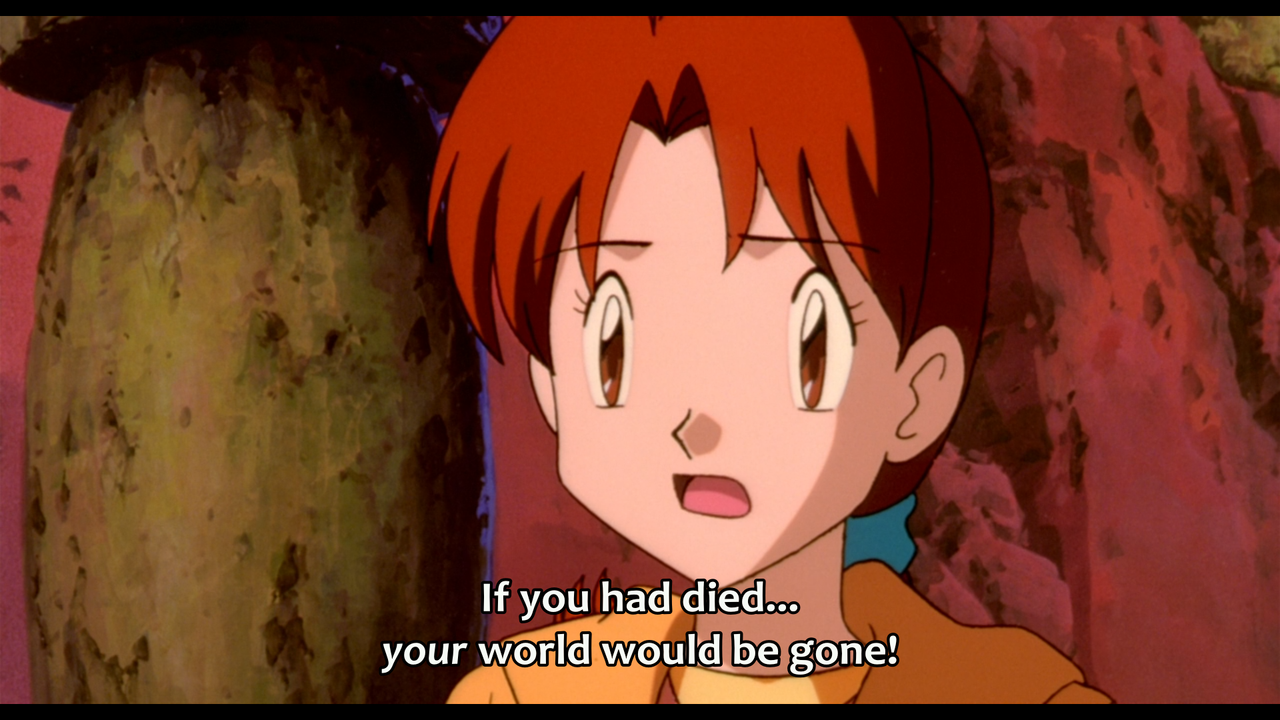
And it matters little that Ash did, in fact, save the world. Even in the face of that achievement, this remains an undeniable truth. This is precisely the deeper meaning behind the words his mother addresses to him in the form of a reprimand during the film’s closing moments; it is as though she were saying: “__Saving the world is not a task that should be carried out at the risk of your life. You are you... and you are no one else. You are a unique and irreplaceable individual, so take care of yourself and continue moving forward toward the goal you truly wish to achieve__.” ____________________
**Lugia: The Origin of Life** A new character, created exclusively for the film, is the Pokémon Lugia, initially referred to as “_Pokémon X_.” This creature, whose original concept was also conceived by Shudo himself, was designed to symbolize the deep ocean currents that safeguard the scientific hypothesis concerning the origin of life.
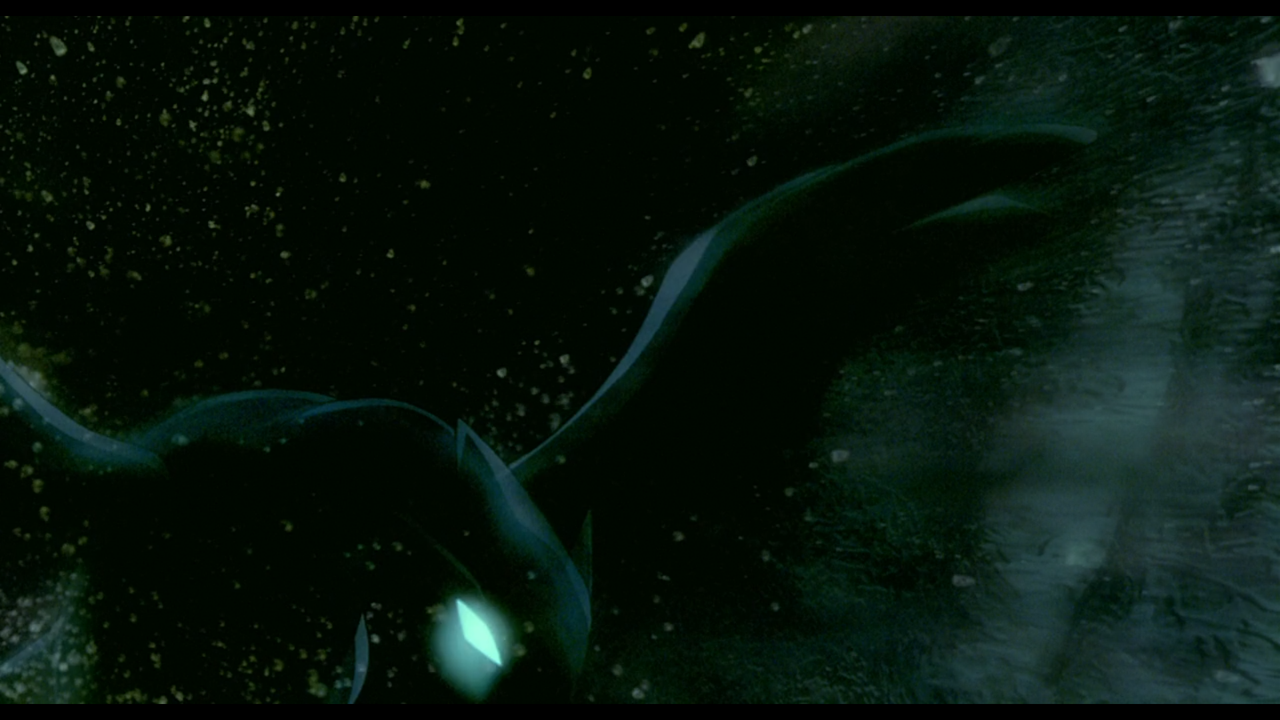
One of the most fascinating aspects of the Pokémon franchise in its early days – perhaps precisely because it was still a world in the process of being defined – was this sense of mysticism that occasionally permeated its narrative universe. X (later renamed Lugia), before even being a Pokémon, was the creature that symbolized the birth of life itself. Precisely because it embodied the absolute maternity of life, it was a primordial force that should have had no need to express itself through human language. After all, Mewtwo was still a Pokémon manufactured through human ingenuity; Lugia, by contrast, was meant to represent the archetype of life’s emergence on Earth and, as such, was an entity that transcended the very concept of sex.
However, since a gender ultimately had to be assigned to it (also in anticipation of possible dialogue, despite the original intention of not having it speak at all), Shudo, in light of the considerations above, associated the character with a maternal personality.
How, then, does this character fit within the framework of coexistence described earlier? The balance of nature, governed by the three Legendary Birds, is disrupted, dragging the planet toward collapse. It is precisely within this context that Lugia appears. As the embodiment of life’s origin, it assumes a crucial role in resolving the crisis. For coexistence and the cessation of hostilities to become permanent rather than temporary, _Lugia’s presence in the world must be perceived as necessary by both humans and Pokémon, to the point that even the three birds come to recognize its authority and vital importance_. This is the reason why the resolution of the crisis could not simply take the form of a stern reprimand or an act of physical domination. Had the conflict been halted through brute force alone, the Legendary Birds would merely have resumed fighting as soon as Lugia departed.
The fact that the world is structured around the relationship between humans and Pokémon also explains why both actively participate in resolving the crisis and, consequently, in this process of coexistence. Ultimately, Lugia comes to embody both life itself and the coexistence of living beings, serving as a symbol for Pokémon and humans alike. It is precisely from this premise that the prophecy featured in the film originates:
“**When the world approaches ruin, the God of the Sea (Lugia) shall appear, and together with an exceptional guardian (that is, a human capable of coexisting with Pokémon), it will calm the wrath of the gods (namely the Legendary Birds, the Pokémon who govern the forces of nature).**”
All of this also ties back to the female identity originally associated with Lugia. Not only because the act of generating life belongs to the maternal sphere, but also because, in relation to Moltres, Zapdos, and Articuno, _Lugia effectively functions as a mother figure._ The clash among the three birds can be interpreted as a conflict between sons, with the mother intervening to put an end to the quarrel between her children. In such a scenario, only a maternal figure is capable of restoring harmony. Were a strong and masculine paternal figure to intervene as an arbiter, the result would be entirely different, since the father would naturally tend to impose his authority in order to stop the dispute. The sons’ instinctive reaction, in turn, would be rebellion, dragging the parent-child relationship into a spiral of conflict. For this reason, the dispute cannot be resolved through mere physical dominance and, likewise, Lugia’s own strength is never portrayed as overwhelming enough to crush the three birds into submission.
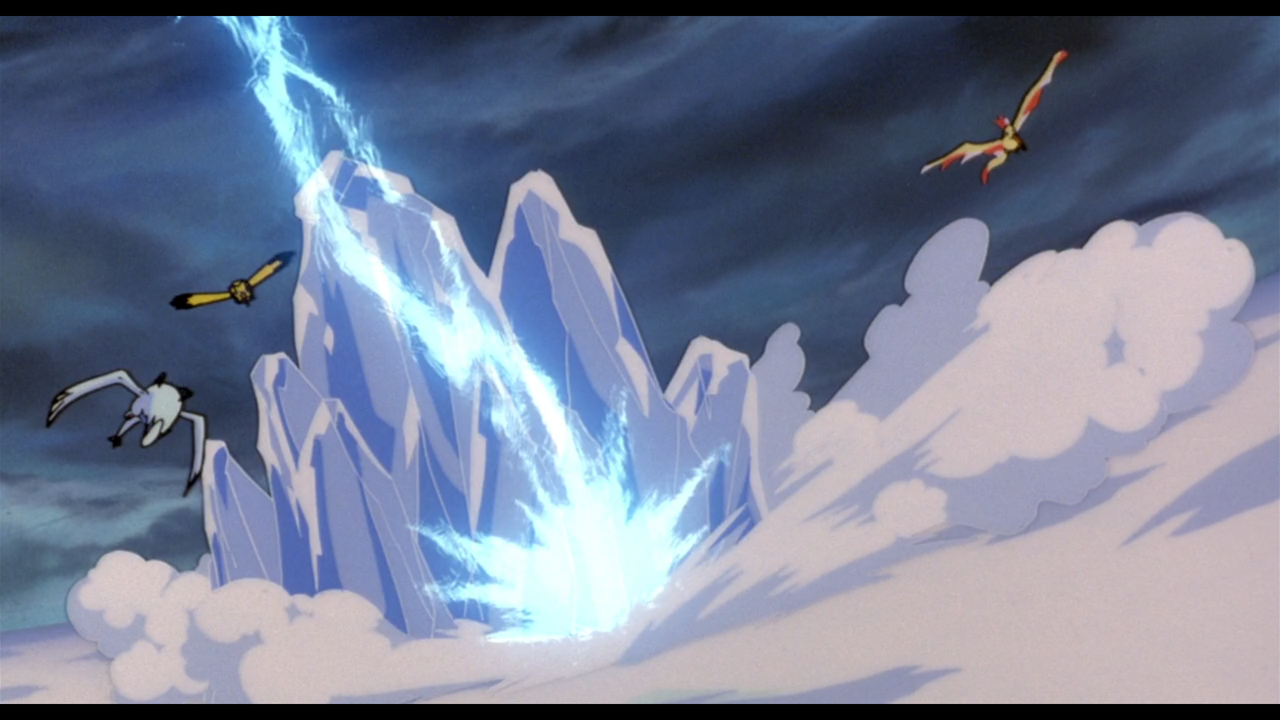
It is exactly the same principle that underlies the words Ash’s mother addresses to her son in the film’s conclusion. This is not a speech that could ever originate from a paternal figure; *it is a reflection that only a mother who gave birth to that child has the legitimacy to express*. In this respect, the essence of Delia’s feelings is identical to Lugia’s. The only difference is that Delia lacks a theoretical understanding of complex concepts such as the global coexistence of life on Earth.
Yet despite the fact that Lugia’s actions were conceived around a maternal and feminine sensitivity, a majority vote eventually determined that the creature would be male. This decision profoundly disrupted Shudo’s plans. Although initially indifferent, he soon realized the enormous obstacle it would create and ultimately found himself facing a severe case of writer’s block. __________________________
**The Choral Dimension of Coexistence** From a narrative standpoint, the solution devised to highlight all of this was to create a **choral work**, one in which every single character featured in the story could, in their own way, become the protagonist of the scene. This is why *The Power of One* is densely populated by a wide variety of characters, all of whom were intended to be portrayed as unique, fascinating individuals endowed with strong personalities, fully consistent with the affirmation of their own self-existence.
Beginning with the main protagonists, this approach manifests itself through the revelation of previously unseen facets of their personalities, distancing them from the stereotypical clichés of the television series and allowing them to play their part as elements within a larger mosaic. Throughout the film, Shudo brings to light nuances and character traits that had until then remained in the shadows.
Ash, the protagonist, is not a boy who spends much time dwelling on existential dilemmas. He is a young man passionately in love with Pokémon, whose thoughts are constantly directed toward his goal of becoming a Pokémon Master. He possesses a straightforward and genuine temperament. He is, in every sense, still a child, completely uninterested in the opposite sex. Within the film, however, Shudo introduces a genuine break from these conventions: *when Ash comes to realize that his actions are connected to a catastrophe of planetary proportions, he experiences a sincere and profoundly human fear* in the face of the responsibilities placed upon him.
Likewise, Misty finds herself personally involved when the young Frula (Melody) wounds her pride by provocatively asking whether Ash is her boyfriend, adding the sarcastic remark: “You certainly have terrible taste.” In Misty’s sharp response – “I’m simply following my own path; it just so happens that Ash is heading in the same direction!” – *Shudo subtly infuses her character with an emotional attachment toward the boy, one of which she herself is not yet fully aware*.
Even so, the author admitted that he was not entirely satisfied with the final portrayal of her character. In the original screenplay, there was a scene intended to emphasize her even further through a moment of selfish anger. After rescuing Ash from drowning and dragging him to shore, Misty was supposed to perform artificial respiration and, seeing that he still was not breathing, begin repeatedly striking his chest with her fists. Shudo’s intention was very precise: to convey a reaction of rage at the prospect that her own existence might lose all meaning if the protagonist were to disappear. Yet, as one might easily imagine, the scene was brutally censored – and therefore removed – by the production executives, who feared that it could be interpreted as an act of gratuitous violence.
While Misty’s characterization was only partially realized compared to Shudo’s original intentions, this experiment fails entirely in Tracey’s case, as the film is unable to provide him with any distinctive traits, ultimately reducing him to a passive observer of events.
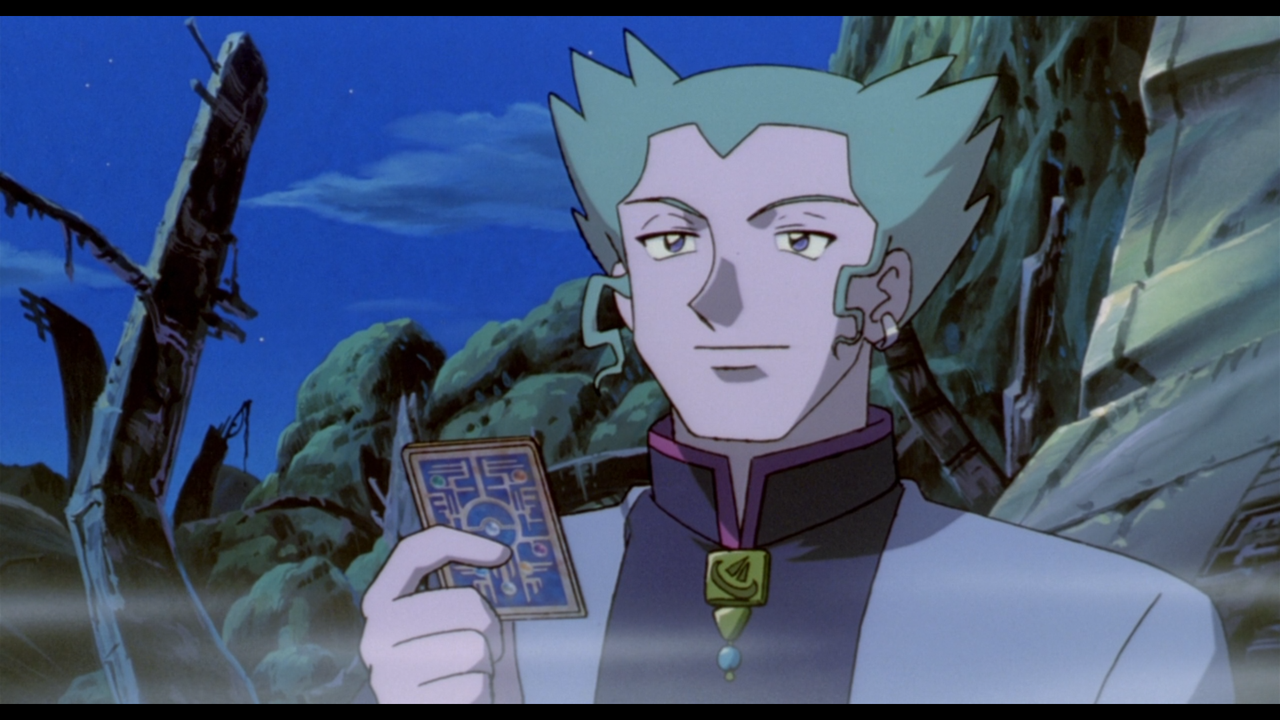
Let us now turn our attention to the film’s antagonist, the collector Lawrence III (Jiraldan in the original version). He is a figure driven by absolute and blind selfishness, indifferent to any universal values and defined by an exaggerated sense of individuality. Indeed, he is the true catalyst of the story: it is his actions that ultimately disrupt the delicate balance of coexistence. In Shudo’s original screenplay, Lawrence was a far more nuanced and complex character, but in the final theatrical version the amount of screen time devoted to him was drastically reduced. Several scenes exploring his character were removed during editing to make room for more action-oriented sequences. As a result, unfortunately, he ends up functioning merely as a narrative device; an antagonist whose sole purpose is to trigger the global crisis. According to Shudo’s original characterization, Lawrence is a compulsive collector whose obsession extends beyond simply capturing Pokémon. Nor does he fit into the category of ordinary collectors who derive satisfaction merely from possessing rare artifacts. *His peculiarity lies in the fact that, once he acquires something he considers valuable, he feels a pathological need to alter and reshape it according to his own personal tastes*. He is therefore an individual defined by a distorted personal identity, whose goal is to transform the universal values of reality into a strictly private system of values. He was never intended to be evil in the conventional sense, because he is entirely indifferent to whether the world is saved or destroyed. *His sole interest lies in constructing a solipsistic microcosm of his own, within which he can contemplate his treasures in complete solitude*. It is through this lens that the final scene in which he appears near the end of the film should be interpreted. Lawrence III, after seemingly losing everything, is shown gazing at a Mew trading card while wearing a sly and defiant smile. Since this moment is one of the few remnants left intact after the cuts, its meaning inevitably becomes obscured, making it difficult for viewers to grasp the scene’s significance.
A central role within the dynamics of the film is played by the Team Rocket trio, whose thematic significance I have already introduced previously. As mentioned, they are perhaps the characters who most forcefully affirm their own “self-existence,” for they are the ones who possess the most unshakable confidence in their own identity.
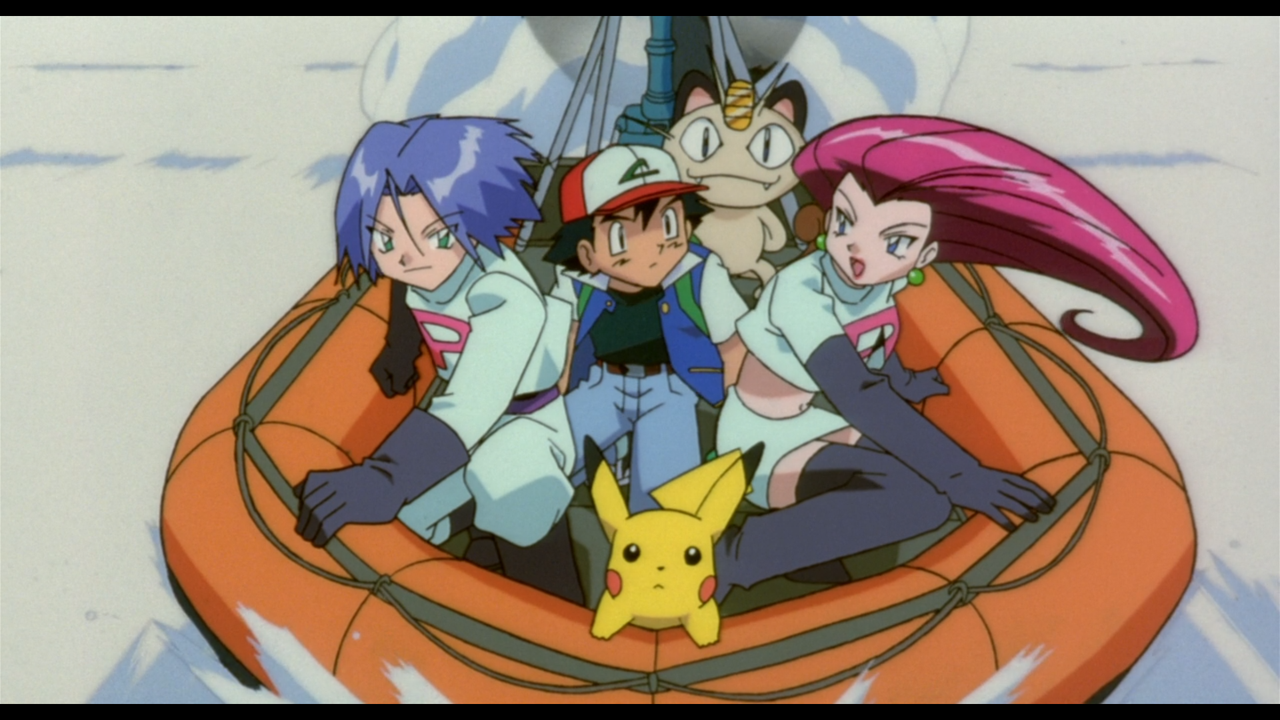
Upon the frozen wasteland, at the moment of greatest danger for the heroes, the trio makes its dramatic entrance. Strictly speaking, it was not necessary for Team Rocket to be the ones who carried out the rescue, and yet the three impose themselves upon the narrative with extraordinary force. They do so while delivering a grandiose declaration in their characteristic theatrical style. After all, if the planet itself were to vanish into nothingness, there would no longer be any possibility for them to perform either good or evil deeds. The Earth – the only stage upon which Team Rocket can exercise its agency – would cease to exist. *It is a claim to their own centrality that extends far beyond the boundaries of the individual film and, according to the author’s vision, even breaks the very rules of screenplay writing*. It is also a symptom of their need for self-expression: *in these scenes, it is as though the trio were shouting directly at the audience, “We are here, and we demand our place on the stage!*”
Shortly thereafter, Lugia rescues Ash, carrying both him and Pikachu upon its back, while the trio desperately clings to the creature’s legs. Lugia struggles to bear the weight of everyone, and Team Rocket quite literally becomes the burden that threatens to bring down the Guardian of the Seas. Realizing this, the three decide to loosen their grip and let themselves fall into the void rather than hinder the completion of the mission. Waiting for them at the end of that fall is an impact against the ice that, in theory, should mean certain death. Their gesture therefore takes the form of an act of heroism and supreme self-sacrifice, concealing a reading perfectly consistent with the logic outlined earlier.
Moreover, in doing so, they leave the stage as “victors,” behaving almost like the true protagonists of the film and avoiding the comedic role assigned to them by the television series. *Rather than appearing as nothing more than an irritating comic burden in the eyes of the world, they choose to risk their lives*. In conclusion, one might say that their definitive answer to the question “**What is self-existence?**” can be summarized in the proclamation: “**The true protagonists of the world are us.**”
As for the other characters, Shudo himself admitted that he deliberately pushed their characterization to exaggerated extremes. Thus, Professor Oak – the highest authority in Pokémon research – travels to the site of the catastrophe, *yet rather than displaying terror at the prospect of the world’s end, he analyzes and explains the situation with almost Olympian calm*. After all, his narrative function is to elucidate the mysteries surrounding the nature of the Pokémon world. He is a man wholly devoted to that professional mission and, regardless of the scale of the catastrophe unfolding around him, remains rigorous and focused upon his duty.
Aboard the same helicopter carrying the scientific expedition is also Ash’s mother. From a realistic perspective, the inclusion of a mother within a scientific task force assigned to investigate a climatic anomaly is absurd. Yet all she needs to say is, “*My son is right at the center of that disaster...*” to justify her presence in the scene. For a woman who raised her child alone, the only true priority is the safety of her son. Faced with danger, she is consumed by anxiety and incapable of simply standing by and watching. From her perspective as a mother, her presence aboard that aircraft is entirely natural. If anything, *this action represents the very essence of Delia’s motherhood: a pure and visceral form of egocentrism*.
Ultimately, for Takeshi Shudo, a choral drama is nothing more than a human mosaic woven through the meeting – and collision – of these individual and entirely legitimate desires for protagonism. >“**My objective was to saturate the film with characters of this kind: individuals driven by a powerful individualistic impulse, even when granted only the briefest amount of screen time.**”
Lawrence the Collector stands as the perfect embodiment of this exaggerated egocentrism. His goal is neither world domination nor world destruction; he is simply the personification of a selfish desire – the urge to possess rare treasures for his private collection.
The elderly village chief of Shamouti Island, for instance, appears on screen only briefly, yet he is a man obsessed with transforming that remote patch of land into a tourist destination, exploiting its ancient legends in order to attract visitors. This is why he is so welcoming toward Ash and his friends.
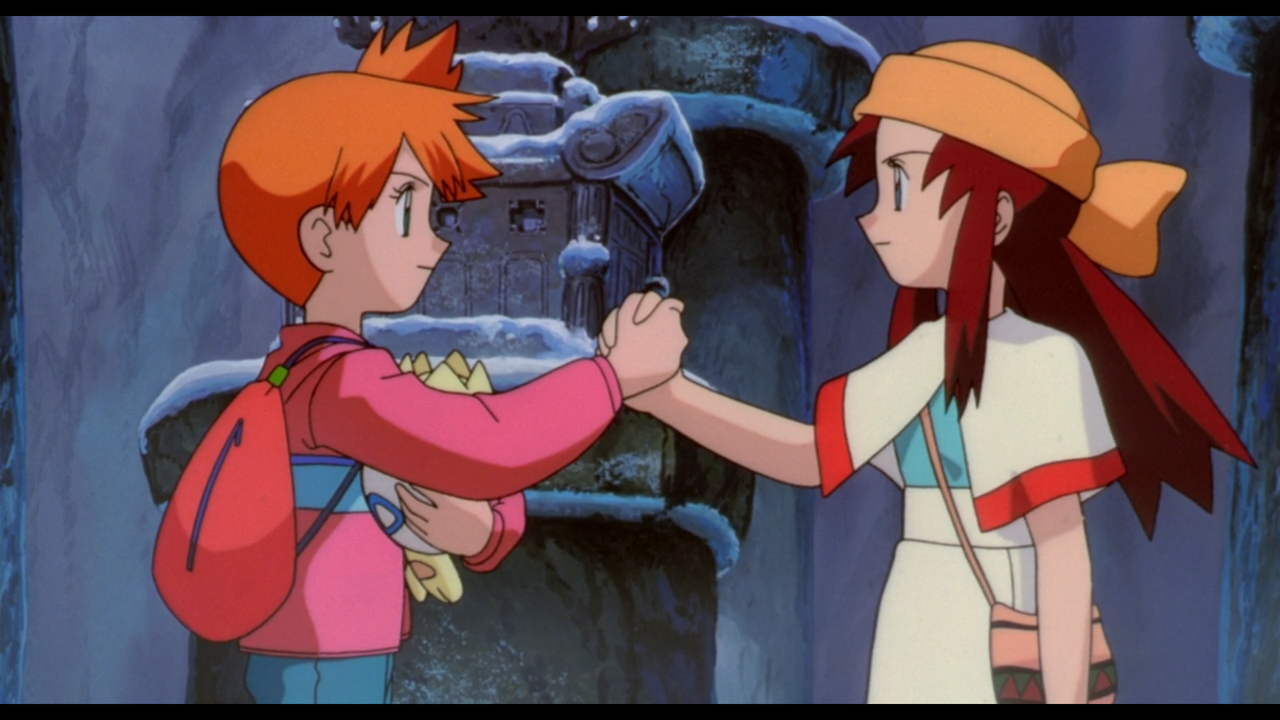
By contrast, the young Melody (Frula) has little genuine interest in the island’s traditions. *She accepts the role of priestess entrusted with playing the legendary flute with the same half-hearted attitude one might bring to a mundane part-time job*. This is already apparent from her clothing, which is decidedly casual and at odds with her ceremonial role. However, the moment she encounters a girl her own age like Misty, a subtle feminine rivalry is sparked within her. This leads her to use Ash as a pretext for teasing Misty, attempting to make her role as priestess appear far more glamorous than it truly is. After all, Melody is still little more than a novice. Speaking of Melody, for whom I developed quite a fondness, one of my favorite scenes in the film occurs when she and Misty work together to save a drowning Ash. At one point Misty tells her: “*You have an important mission to fulfill; you have to play the flute. I’ll take care of my ‘hopeless case’ myself..*.” The two girls then exchange a knowing glance and a smile. It is one of my favorite scenes precisely because **it serves as the official recognition of what each of them is capable of doing** – in other words, as Shudo himself might say, **a confirmation of their own self-existence.**
**Conclusion** The Power of One is structured as a film in which each character acts solely according to their own impulses and desires in response to a global anomaly (which is precisely what the author’s concept of coexistence embodies). There is no coordinated or premeditated cooperation; rather, what emerges is a *“mosaic of selfishness”*.
**Every individual existence acts according to its own nature, and it is precisely through this mosaic of personal actions that coexistence comes into being**. In order for such a balance to be achieved, it is necessary to recognize the gap and distinction that separates one’s own self from the identities of others. And if, in the course of this process, something is destined to perish, then that sacrifice too must be understood as a necessary step toward coexistence.
COMMENTS
0 Comments
SIMILAR ANIMES YOU MAY LIKE
 MOVIE2017, ActionPokémon the Movie: I Choose You!
 MOVIE2002, ActionPokémon Heroes
 MOVIE1998, ActionPokémon: The First Movie
 MOVIE2000, ActionPokémon 3: The Movie
 MOVIE2018, ActionPokémon the Movie: The Power of Us
SCORE
- (3.55/5)
TRAILER
MORE INFO
Ended inJuly 17, 1999
Main Studio OLM
Favorited by 424 Users
