

COCOON – ONE SUMMER OF GIRLHOOD
STATUS
COMPLETE
EPISODES
1
RELEASE
March 30, 2025
LENGTH
62 min
DESCRIPTION
San and Mayu are two schoolgirls living in Okinawa during the closing months of the Pacific War. Together with their classmates, the two friends are drafted into the war effort as nurses for wounded soldiers. When ordered to die for their country, the remaining members of the group escape only to face the harsh environment of a tropical paradise that has become a hellish battlefield.
CAST

San

Marika Itou

Mayu

Hikari Mitsushima

Tamaki

Youko Hikasa

Hina

Rena Motomura

Mari

Chinatsu Akasaki

Yuri

Aoi Koga

Kaede

Yume Miyamoto

Shiho

Izumi Aoyagi
Kaho

Miyuki Sawashiro

Sensei

Umeka Shouji
Sonohokasei

Hinano
Episodes are being prepared. Check back soon.
RELATED TO COCOON – ONE SUMMER OF GIRLHOOD
REVIEWS

atomx
While Cocoon discards some of the author’s original messages it still manages to be a well-rounded anti-war movieContinue on AniListIt seems like society has reached the general consensus that war is bad and modern media has moved along with it. Movies like American Sniper and the post-iraq patriotic feel-good mindset are out and critical portrayals of soldiers and citizens are what the public wants. No more glorifications of soldiers but the harsh reality that the scarred people, involved in war, are left with.
Cocoon is no exception to this but it gives a different view on a topic that has become somewhat stale. Serving as the basis for the story are the Himeyuri students (also called “Lily Girls”) - A group of 240 women and girls that were led into battle under the false pretense that the Japanese army would easily defeat the American invasion. They enthusiastically packed their school supplies thinking they would be safe from any danger and able to prepare for the coming school year. Instead they were positioned in an underground cave hospital that was constantly being bombed and under gunfire.
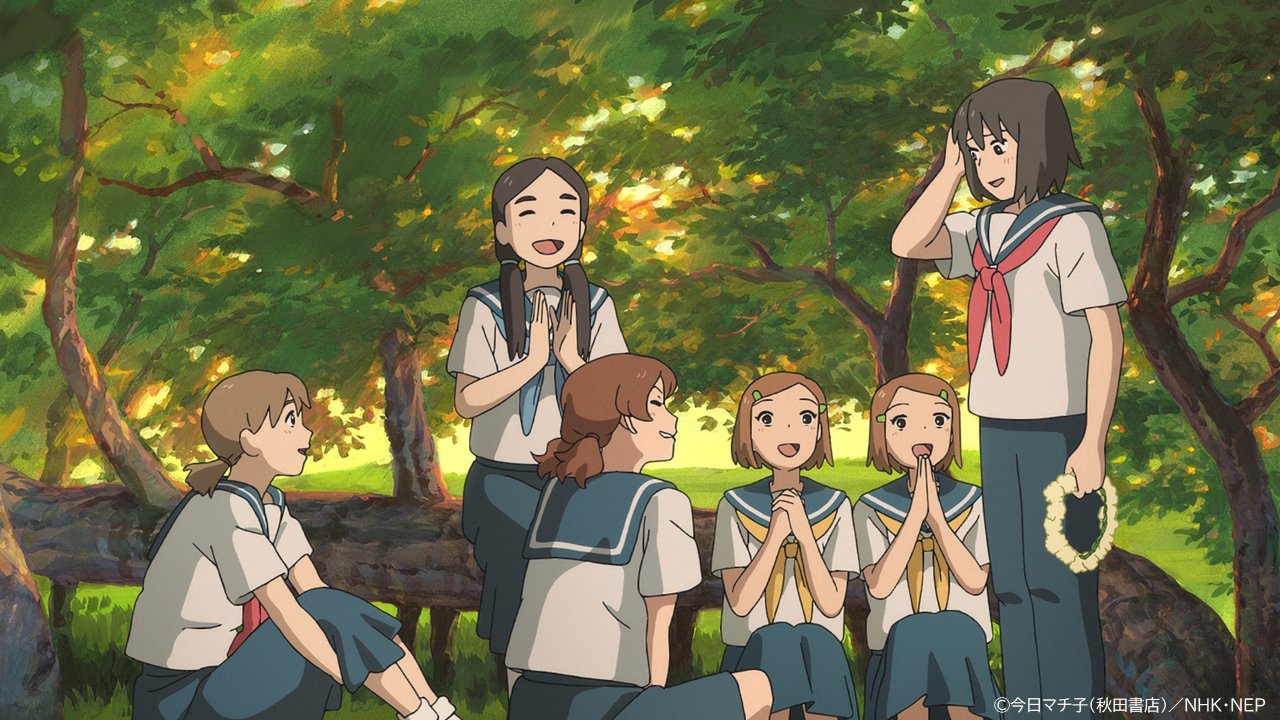
The central conflict of Cocoon lies not only in the ongoing war but in the relationship between the protagonist Mayu and her best friend San. Stationed in a forest with the rest of their class and a teacher they gather resources and information to help the army. When Mayu spots the shadow of an aircraft in the sky she is hesitant to tell the lookout and only shares her intuition with San, who informs the lookout. It turns out that her instinct was right and the girls quickly evacuate and manage to evade the enemy's bombs. This conflict between Mayu’s reserved nature and San’s outgoing one becomes the central theme of the adaptation and ultimately serves as a way to express its pacifist message.
War changes people and it does not care if those people are innocent highschool girls. After having to move to an underground cave hospital, where they nurture wounded soldiers, the situation becomes increasingly more gruesome. One of their friends is burned alive by a bomb and slowly the girl’s numbers decrease. Yukimitsu Ina depicts this in a great way by simply not depicting it at all. These girls are no longer citizens but cannon fodder. Their death is not acknowledged, not because it isn’t meaningful, but because the country that they are fighting for has reduced them into something that may as well be called lesser of a human.
Alongside the army’s deteriorating situation are Mayu and San’s own mental state. Mayu is torn between the cruelty of the war and the “owed” responsibility to their country. Around them their classmates are dying or getting assaulted by traumatized soldiers and still they have to keep on going. After notice of dissolution reaches them it all takes a turn for the worse. They are left alone in the middle of war and the only way to a safer place goes through the middle of the enemy's territory.
The ending might seem disappointing for anyone that has read the original and without spoiling it I will say that it is necessary considering the plot and story changes.
Regarding the animation and general art direction Cocoon is nothing short of perfect. It’s the first feature film of Studio Sasayuri which was founded by Ghibli-Alumni like Hitomi Tateno (In-Between Animation Inspection) or Yoichi Watanabe (Art Director) and the resemblance is almost uncanny. From the way a sulking girl walks away to how an angry character's head comes into frame; it looks just like any modern Ghibli movie.
Where Cocoon fails is at adapting Machiko’s feminist perspective on war. The original manga places a much bigger focus not only at the girls deteriorating mental health but also at the brutality of the war. Girls are shown with burned backs or straight up dying in a pool of blood. Furthermore the soldiers are faceless white creatures representing nothing other than their uniformity and stripped identities. Men are the central group responsible for the war and San even directly says that she hates men.
“Depicting the soldiers as white shadows came from thoughts I had when I was a girl where, taking the idea of purity to its furthest conclusion, I pretended as if men didn’t exist at all ultimately.” (Kyou Machiko)
Another aspect that is changed is the symbolism of the Cocoon and San’s general development. Whereas the adaptation uses it as a way to show San overcoming the cruelty of war and how it changes people for the worse, Machiko frames the Cocoon as San’s coping mechanism to escape the war. She doesn’t suddenly turn pacifist and sway’s the girl's opinions by giving some big speech. All she is is powerless and her only way of escaping it is her imagination.

daibaapologist
A mediocre, sanitized adaptation of an excellent manga.Continue on AniListThis review contains non-detailed discussions of gore, sexual violence , and suicide, as well as spoilers for both the film and the manga version.
People are instinctively wary of war stories from 20th-century Japan. Imperial Japan was an aggressively expansionist military power that committed some extremely grim crimes both prior to and during World War 2. Japan is also famous for denying those crimes.
Japan is, at the same time, not a monolith, and the original Cocoon manga is extremely critical of the Japanese army.
There are good things in the Cocoon anime, though largely soured by my issues with the story and decision to cut or soften certain scenes. The animation and voicework are both effective; it's a very pretty film. A story also doesn't necessarily need to make everything loud and obvious and happen onscreen to make sense. One especially upsetting scene involving sexual violence is actually improved by the anime's decision to be more discreet, cutting away from the act but still displaying the aftermath.
Cocoon is a story of young girls being fed to the war machine, having been taken in by nationalist propaganda. Or at least, the manga is. There are a fair amount of gory and disturbing scenes depicting rotten corpses, infected wounds, and the mental toll that constantly being surrounded by death and violence takes. It's not a fun read, but these aren't present to shock the viewer; they're to illustrate the horrors of the situation.
Almost none of this is depicted in the anime, at least not in a meaningful or thematically interesting way.
Instead, many scenes - largely the most significant and haunting ones - are either softened or entirely removed. Most blood is depicted as flower petals, and while in-text this is meant to reflect the state of mind of main protagonist San, it feels patronizing to the viewer. This is a story about the horrors of war that doesn't want to depict the uncomfortable things from the manga; the most egregious use of flower-petal-gore comes from a scene where many of the survivors are gunned down. This scene is not in the manga.
Many of the most heartwrenching deaths from the manga that get to stay in the film are offscreen, or replaced by scenes like this. Most character reveals and development are absent. The protagonists (and audience) run through pastoral landscapes that appear unmarred by fighting, even at the most dire of moments.
Many lines are changed as well, and while they convey similar emotions, they don't convey the same meaning. A group of survivors decide that it's better to die than to be captured. The rationale for this differs between the anime and manga, and the anime's refusal to discuss this beyond a vague "the soldiers said to" undermines the original purpose of the scene. The final scene has San reunite with her family in a camp, where her mother comments that the Americans are treating them better than their own soldiers (though they're still prisoners). The final lines in both versions are this:
I may have wings, but I'm unable to fly. Which is why... I chose to live instead.
In the manga, this reads as a rejection of the propaganda that led to the survivors from earlier ending their lives (among other scenes throughout the manga). But because the anime refuses to contend with that propaganda, it becomes a sort of vaguely inspirational line. The emotional weight it carries is lost.
It is a series of self-defeating decisions that weaken the film. Even the Ghibli films from which Cocoon draws its visual style from are willing to portray more than this. It's ineffective as an anti-war film beyond a vague, overwrought "war is bad" message. I would hope people think war is bad.
The most biting text of the manga has been replaced with barely-legible subtext, and that's where the disappointment lies. It's perfectly decent in a vacuum, but this story just doesn't exist in one.

Anita1995
Watch It Before the World Forgets It ExistsContinue on AniListOkay so I need to talk about Cocoon because I genuinely haven't stopped thinking about it since I watched it.
This is a 60-minute anime special set during the final days of World War II, following a group of schoolgirls in Okinawa who get drafted as battlefield nurses during the closing months of the Pacific War. It sounds like a lot, and it is. It absolutely is. But it handles everything with so much care that I think it's one of the most important anime I've seen in years.The story is based on the real-life tragedy of the Himeyuri students, teenage girls from elite schools who were essentially lied to and sent to the front lines, promised an easy Japanese victory and a safe posting far from battle. What they got instead was the trenches, dying soldiers, and a Japanese military that treated them as disposable. When the war turned, they were simply abandoned. No help, no plan, just "go home." Many of them didn't make it. Many ended their own lives. The film doesn't look away from any of this.
Now, the artistic choices. This is where Cocoon goes from good to genuinely extraordinary.
When the girls die, their blood doesn't pour out like the soldiers' it becomes flowers. Beautiful, drifting petals. In death, they get back the peace of the fields they used to know. It's heartbreaking and gorgeous at the same time. And the reason I love it so much is what it says without saying anything these girls deserved better. Their deaths were not the same as the men's deaths. They were taken from something soft and good and thrown into something they were never supposed to be part of.But here's the thing that visual choice is NOT applied to Mayu's worst moment in the film. When "she" is shot, there are no flowers. No poeticizing. No beautiful framing to soften what it is. The film just sits in the weight of it, uncomfortable and real. And I think that's the most powerful choice the whole film makes. The flower imagery is about death and grief and loss but what happens to Mayu while she's still alive is not something to be aestheticised. It deserves to be felt fully, plainly, without softening. That decision alone shows how much thought went into this.
There's also this detail I couldn't stop thinking about: the Japanese soldiers in the story have no distinguishing facial features. No defined faces at all. It's a conscious choice from the original manga this is not their story. Their presence is a threat, not a perspective. It puts the camera firmly with the girls and never lets it slip away to the men who had power over them.
The title itself, Cocoon, is a metaphor that runs through the whole film the silkworm, the transformation into beauty, the maturity these girls will never get to reach. And also, silkworms are cared for by men, only to be harvested and killed at their peak. It's not subtle, but it doesn't need to be.
The studio behind this is Sasayuri, founded by former Studio Ghibli staff, with veteran animator Hitomi Tateno as animation director and producer, the same person who worked on films from My Neighbor Totoro all the way to When Marnie Was There. And it shows. If you showed a random clip to any anime fan, I genuinely think most of them would say it looks like a Ghibli film. The warmth in how the girls' school life is drawn, the way light moves, the softness of the early scenes before everything falls apart it has that quality. The music by Kensuke Ushio (A Silent Voice, Chainsaw Man) is minimalist but precise it knows when to pull back and just let the pain breathe.
The ending. I won't give details, but I will say it earns every bit of what it's reaching for. It doesn't give you easy comfort, but it does give you something true and something hopeful in the quietest possible way. San's final words essentially say: I broke out of my cocoon. I grew wings. I still can't fly. But I chose to keep living. That's it. That's the whole film.
If you loved In This Corner of the World or The Wind Rises the kind of war film that doesn't glorify anything, that just watches ordinary people survive extraordinary horror this is for you. It's anti-war without screaming it. It just shows you what war costs and trusts you to feel it.
My only real frustration is that this is almost certainly not going to get the recognition it deserves. There's currently no confirmed international release, and the subject matter gendered wartime violence, sexual assault, mass suicide is exactly the kind of thing that gets quietly passed over by wider audiences. That's deeply unfair to the real girls whose story this is. Watch it if you can find it. It matters.Firmly in my favourites. Not an easy watch. Completely worth it.
COMMENTS
0 Comments
SIMILAR ANIMES YOU MAY LIKE
 MOVIE2016, DramaIn This Corner of the World
 ANIME2017, AdventureGirls' Last Tour
 MOVIE1988, DramaGrave of the Fireflies
 ANIME2017, ActionLand of the Lustrous
 MOVIE1983, DramaBarefoot Gen
 MOVIE1991, DramaWho's Left Behind?
 OVA1993, ActionThe Cockpit
 ANIME1978, AdventureFuture Boy Conan
 MOVIE2013, DramaThe Wind Rises


SCORE
- (3.7/5)
TRAILER
MORE INFO
Ended inMarch 30, 2025
Main Studio Sasayuri
Favorited by 77 Users
Hashtag #COCOON